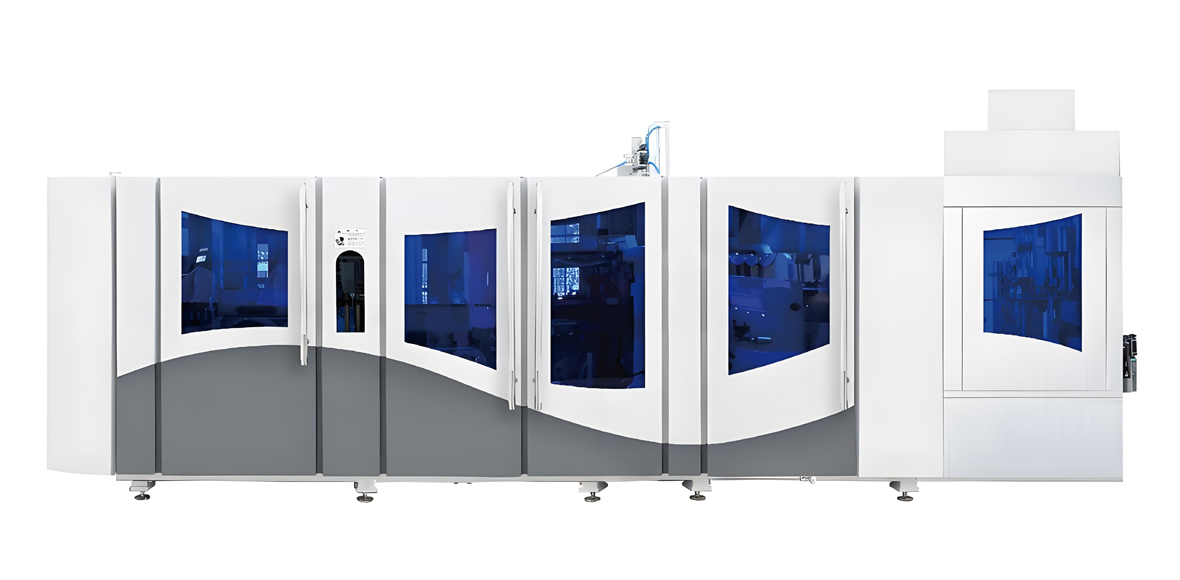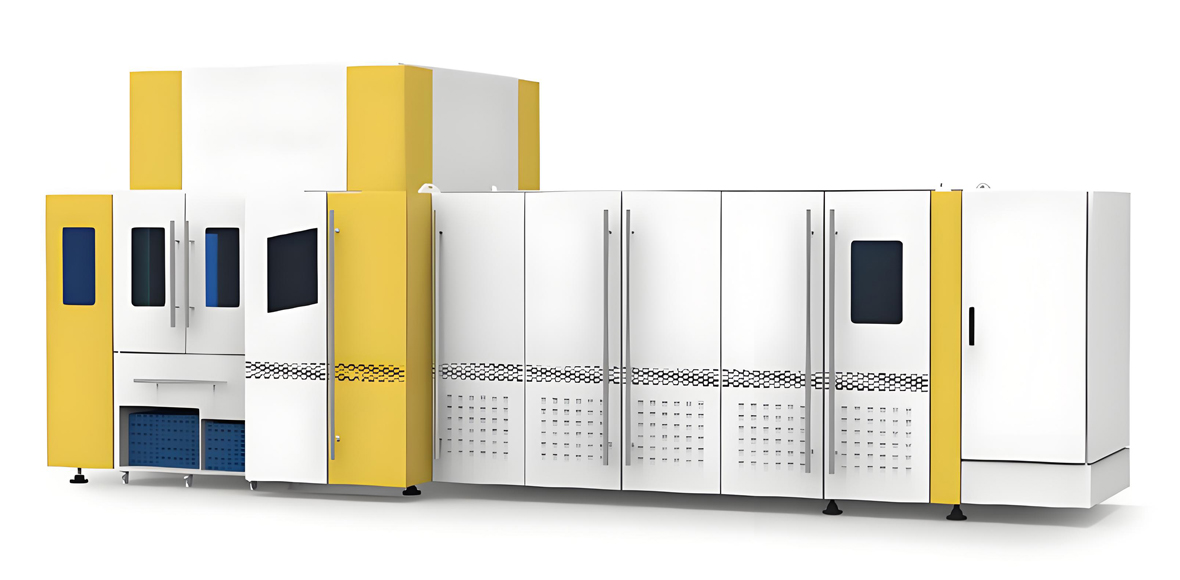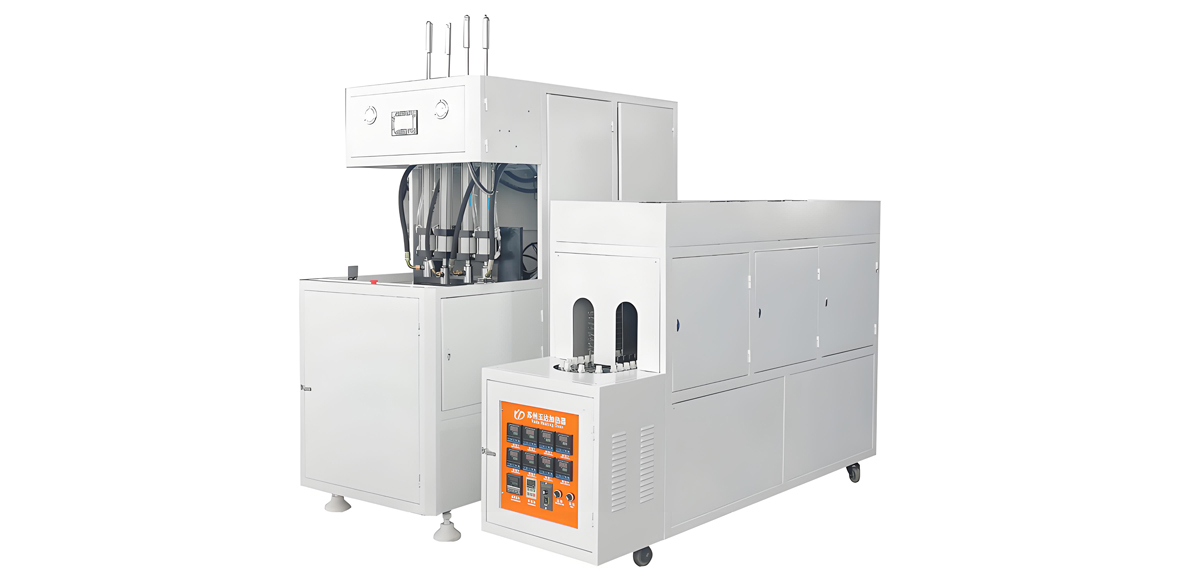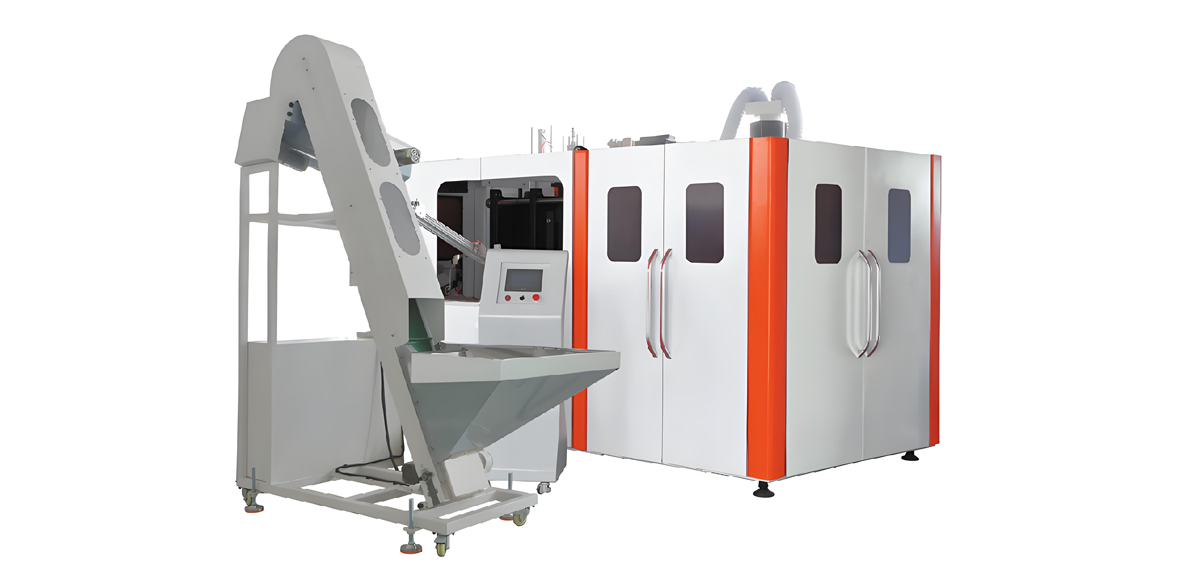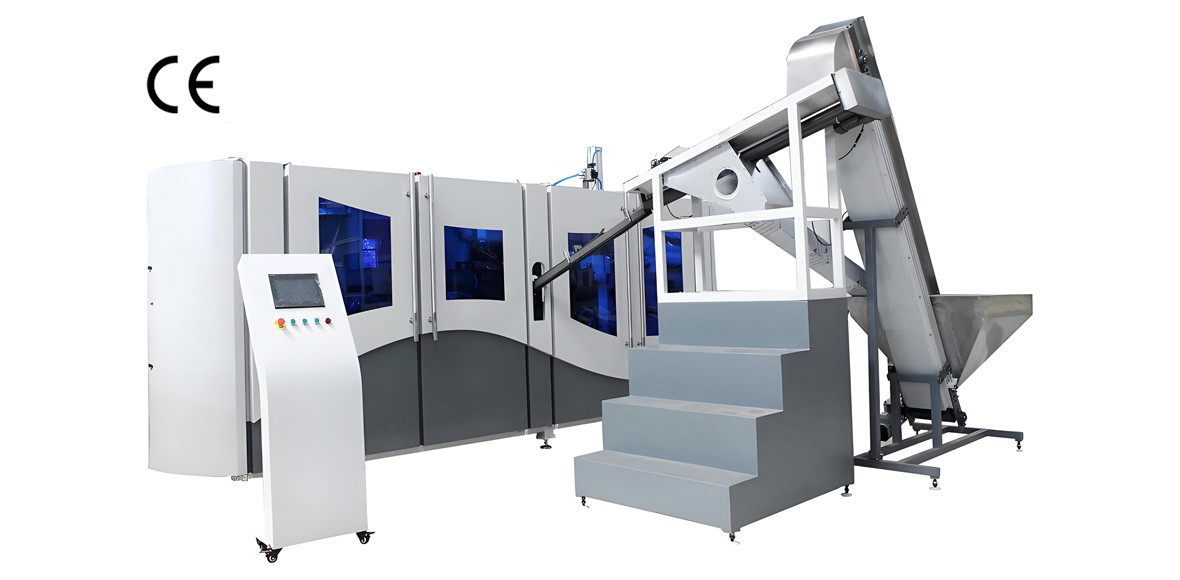
Stretch blow molding of polyethylene terephthalate, widely known as PET, is a process governed as much by heat as by mechanics. The same polymer that delivers a brilliantly clear, lightweight, and tough bottle for still water becomes a foggy, brittle, or burst-prone container the moment its temperature profile or raw material formula drifts outside the narrow window that biaxial orientation demands. For any producer running a PET bottle blow molding line, the two levers that decide yield, clarity, top-load strength, and burst resistance are the reheating temperature curve and the preform material formulation. This article explains, in practical engineering terms, how intrinsic viscosity, glass transition, melting point, crystallization windows, preform drying, infrared oven zoning, blow pressures, stretch-rod dynamics, heat-set crystallization, and raw material modifiers such as IPA copolymer, MXD6 nylon, acetaldehyde scavengers, oxygen scavengers, UV absorbers, rPET, and color masterbatch interact on the production floor. YuDa, a Wanplas factory and a top manufacturer of PET bottle blow molding machines with more than twenty years of experience and twenty-plus patents, builds FGX high-speed machines and BFC combi-blocks around exactly these process variables, and the guidance below reflects the operating knowledge that separates a stable, high-yield line from one plagued by pearl-white bodies, paneling, and stress cracks.
PET Material Fundamentals for Blow Molding
Before any lamp is switched on, the technician must understand the polymer being molded. PET is a semicrystalline thermoplastic whose mechanical and optical behavior during stretch blow molding is dictated by its molecular weight, thermal transitions, and crystallization kinetics. Intrinsic viscosity, abbreviated as IV and measured in deciliters per gram, is the single most quoted indicator of PET molecular weight and therefore of bottle toughness. In bottle-grade PET the IV normally spans 0.72 to 0.86 dL/g. A water bottle, which faces only mild internal pressure, is usually made from resin around 0.72 to 0.78 dL/g. A carbonated soft drink bottle, which must resist sustained internal pressure from dissolved carbon dioxide, is typically formed from 0.78 to 0.82 dL/g material. A hot-fill bottle, which must hold shape at high temperature while retaining crystalline stability, often uses 0.80 to 0.86 dL/g resin and is further crystallized in the heat-set stage.
The glass transition temperature, denoted Tg, is the point at which the amorphous PET chains gain enough mobility to be oriented. For bottle-grade PET, Tg sits near 76 to 80 degrees Celsius. Below Tg the material is glassy and brittle; stretching it produces fracture rather than orientation. The melting point of PET lies between 245 and 255 degrees Celsius, and the practical crystallization temperature window is 120 to 180 degrees Celsius. When a preform is reheated, the goal is to bring the wall into a narrow band just above Tg but far below melting, where the polymer is rubbery enough to draw and orient yet not so hot that it crystallizes uncontrollably or melts. The natural stretch ratio, often called NSR, is the ratio at which the material spontaneously orients without external force; exceeding NSR during forming tends to over-stretch and whiten the wall, while falling short leaves the wall under-oriented and weak. Every temperature decision downstream flows from these three numbers: Tg near 76 to 80 degrees Celsius, melting at 245 to 255 degrees Celsius, and the crystallization window of 120 to 180 degrees Celsius.
| PET grade IV (dL/g) | Typical bottle type | Key application and requirement |
|---|---|---|
| 0.72 to 0.78 | Still water bottle | Low internal pressure, focus on clarity, lightweighting, and low acetaldehyde for taste neutrality |
| 0.78 to 0.82 | Carbonated soft drink bottle | Sustained CO2 pressure, requires higher burst strength and consistent wall orientation |
| 0.80 to 0.86 | Hot-fill bottle | Heat-set crystallization to survive 85 to 95 degrees Celsius filling without paneling |
| 0.70 to 0.84 (variable) | rPET-containing bottle | Recycled content blend, IV compensated by heating and formula adjustment |
The thermal transitions also dictate safe handling. Crystallized PET, often called CPET, has a much higher heat-deflection temperature and is used where the container sees oven or hot-fill duty, whereas amorphous PET is clear and used for cold or ambient filling. The stretch blow molding machine must therefore keep the temperature of the reheated preform high enough to orient but low enough to avoid crossing into the melt or heavy crystallization zone. The interplay between IV, Tg, melting point, and the 120 to 180 degrees Celsius crystallization window is the foundation of every setpoint an operator enters into the FGX series control system.
Preform Drying and Moisture Control
PET is hygroscopic, and ambient moisture absorbed into the preform or pellet begins to hydrolyze the polymer chain the moment it is reheated. Hydrolysis cleaves molecular chains, dropping IV and destroying the very toughness the bottle depends on. The rule that governs the drying step is uncompromising: the preform moisture content must be at or below roughly 50 ppm before it enters the heating oven. Above that threshold, IV loss of 0.02 to 0.05 dL/g is typical, and the resulting bottle is more prone to stress cracking and burst failure. A dehumidifying dryer with a desiccant bed is therefore not optional equipment but a baseline requirement of any credible PET blow molding line.
The drying specification used across the industry is consistent. The dew point of the drying air must reach at or below minus 40 degrees Celsius, which keeps the air aggressively dry. The drying temperature is set between 160 and 175 degrees Celsius; too low and moisture cannot be driven off, too high and the resin begins to stick or crystallize inside the drying hopper, which then causes feeding problems. The residence time in the dryer runs from four to six hours, long enough for heat to penetrate the preform stack and for the desiccant air to carry away the liberated moisture. Many plants monitor moisture with an inline meter, while others verify periodically by weighing a sample before and after drying or by measuring IV drop across the process. The practical consequence of ignoring drying is invisible at the oven but shows up later as pearl-white stress zones and premature bottle failure under load.
Operators should also watch the regrind path. Rinsed and repelletized rPET carries more moisture history and surface contamination, so when recycled content climbs, drying attention tightens rather than loosens. Some lines add a crystallizing dryer upstream of the dehumidifying dryer specifically to prevent the rPET or virgin pellet from agglomerating below its sticking point. For a Wanplas factory such as YuDa, the recommendation is to standardize the drying recipe per material grade and to lock it into the recipe management system so that shift changes do not silently reopen the hydrolysis window.
| Drying parameter | Specification | Consequence of deviation |
|---|---|---|
| Dew point | At or below minus 40 degrees Celsius | Higher dew point leaves moisture in resin and accelerates hydrolysis |
| Drying temperature | 160 to 175 degrees Celsius | Over-temperature causes sticking or premature crystallization in hopper |
| Drying time | 4 to 6 hours | Too short leaves core moisture, too long wastes energy |
| Moisture content | At or below 50 ppm | Excess causes IV drop of 0.02 to 0.05 dL/g and hydrolysis degradation |
Infrared Heating Oven Temperature Zoning
The reheating oven is where the temperature formula is executed. A modern PET blow molding machine such as the YuDa FGX series uses an infrared heating oven with multiple lamp layers, typically six to twelve layers, arranged so that the preform hangs neck-down and passes the lamps in a controlled orbit. Each layer is a bank of halogen or ceramic infrared lamps, usually rated at 2000 to 3000 watts per lamp, whose power is set as a percentage of full output. The art of oven setup is to deliver a temperature profile along the preform length that matches the stretch ratio each zone must achieve: the neck region must stay cool to protect threads, the body mid-section must reach the highest temperature for the greatest draw, and the base must be warm but controlled to avoid bottom defects.
The layer power logic follows a predictable pattern. The zone just below the neck, where little stretch occurs and thread integrity is critical, is set to roughly 30 to 45 percent lamp power. The bottle body mid-section, which experiences the largest radial and axial draw, is driven to 70 to 90 percent. The preform base, which must form the support and resist stress cracking, sits at 45 to 60 percent. This gradient is not arbitrary; it mirrors the stretch ratio map of the final bottle. A preform that is overheated at the neck loses thread dimension and leaks at the cap seal, while one that is too cool at the body cannot be drawn thin and uniform.
| Oven zone | Lamp power percentage | Target surface temperature | Purpose |
|---|---|---|---|
| Neck and just below neck | 30 to 45 percent | Below 90 degrees Celsius | Protect threads and neck finish from deformation |
| Body mid-section | 70 to 90 percent | 95 to 118 degrees Celsius (by bottle type) | Maximum draw and biaxial orientation |
| Preform base | 45 to 60 percent | Near 100 to 110 degrees Celsius | Form base support, avoid bottom stress cracking |
The absolute surface temperature targets differ by bottle type. Still water bottles are reheated to a surface temperature of about 95 to 115 degrees Celsius. Carbonated soft drink bottles, which need a tougher, more oriented wall, are run hotter at 105 to 118 degrees Celsius. The inner-to-outer wall temperature difference must be held within about 6 degrees Celsius; a large through-wall gradient means the inside lags the outside, producing uneven orientation and a bottle that fails top-load or burst tests. After the lamps, an equilibration dwell of 8 to 20 seconds lets the heat soak through the preform wall so that the temperature is uniform when the stretch rod enters. Skipping or shortening equilibration is a frequent cause of local cold spots and visible orientation streaks.
Two cooling subsystems protect what the lamps must not heat. The oven body uses forced-air cooling, often blown across the lamp bank, to keep the oven structure and the preform neck region from soaking in radiant and convective heat. Separately, neck cooling water at 8 to 15 degrees Celsius circulates through a collar or mandrel around the preform neck so the threads hold their dimension. Without neck cooling, the neck drifts out of tolerance and the cap cannot seal; with it, the neck stays below its deformation point while the body reaches full orientation temperature. The combination of layered lamp control, equilibration dwell, oven air cooling, and 8 to 15 degrees Celsius neck water is the practical realization of the temperature formula on a YuDa FGX machine, and the 38.1 millimeter minimized heater distance in that design is what lets the oven hit these profiles with roughly 30 percent lower electricity use than a conventional wide-spaced oven.
Blow Molding Process Parameters
With the preform correctly reheated, the forming stage converts heat and force into a biaxially oriented bottle. The sequence on a stretch blow molding machine is governed by a small set of pressure and timing parameters. Pre-blow, sometimes called the low-pressure pre-inflation, is applied at 0.6 to 1.2 megapascal to begin expanding the warm preform away from the mold wall before the high-pressure stage. The pre-blow delay, the time between stretch-rod contact and pre-blow onset, is set between 0.10 and 0.35 seconds. This delay is one of the most sensitive tuning knobs: too short and the base is blown before material can distribute, too long and the wall thins at the shoulders.
High-pressure blow follows at 2.5 to 4.0 megapascal, pressing the preform firmly against the mold surface so the bottle takes its final shape and the cooling mold freezes in orientation. The stretch rod, which mechanically draws the preform axially, moves at 1.0 to 1.6 meters per second. Its speed sets how much axial orientation is introduced before the air completes the radial draw. The stretch ratios that result define the bottle’s mechanical quality. The axial stretch ratio, the ratio of final bottle length to preform length, runs 2.0 to 3.2. The radial stretch ratio, the ratio of final diameter to preform diameter, runs 3.5 to 4.5. The total area stretch ratio, combining both directions, is typically 8 to 14. Falling below these ratios leaves the wall under-oriented and cloudy; exceeding them over-stretches and whitens the material.
| Bottle type | Preform surface temp | Pre-blow / HP (MPa) | Stretch ratio (axial x radial) | Notes |
|---|---|---|---|---|
| Still water bottle | 95 to 115 degrees C | 0.6 to 1.0 / 2.5 to 3.2 | 2.0 to 2.8 x 3.5 to 4.2 | Prioritize clarity and low acetaldehyde |
| Carbonated soft drink bottle | 105 to 118 degrees C | 0.8 to 1.2 / 3.0 to 4.0 | 2.4 to 3.2 x 3.8 to 4.5 | Maximize burst strength and base support |
| Hot-fill bottle | 100 to 115 degrees C pre-blow, mold 120 to 160 degrees C | 0.8 to 1.1 / 3.0 to 3.8 | 2.0 to 2.8 x 3.5 to 4.2 | Heat-set double-blow raises crystallinity |
| rPET-containing bottle | Oven up 2 to 5 degrees C vs virgin | 0.7 to 1.1 / 2.8 to 3.8 | 2.0 to 3.0 x 3.5 to 4.4 | Compensate IV fluctuation and color b* |
The timing of the stretch rod relative to the air is central. A well-tuned water bottle might use a pre-blow delay near 0.15 to 0.25 seconds with a stretch-rod speed toward the lower end of the 1.0 to 1.6 meters per second band, while a carbonated bottle pushing for maximum burst resistance uses a slightly longer delay and a faster rod to force material into the base. The high-pressure stage is held long enough for the mold to cool the bottle so it demolds without sticking or distortion. Because the FGX series uses a servo-driven cam linkage that integrates mold opening, mold locking, and bottom-mold elevation in one motion, these timing windows are repeatable from cavity to cavity, which is what allows a stable temperature formula to translate into a consistent bottle rather than a scatter of good and bad parts.
Heat-Set Process for Hot-Fill Bottles
Standard stretch blow molding leaves the PET largely amorphous, which is ideal for clarity and cold filling but fails when the bottle must hold hot liquid. A hot-fill bottle is filled at 85 to 95 degrees Celsius, and an amorphous PET bottle would soften, panel, and lose its shape under that heat and the resulting vacuum as it cools. The heat-set process solves this by deliberately crystallizing the oriented wall so its heat-deflection temperature rises above the fill temperature.
In a heat-set machine, the blow mold is heated to 120 to 160 degrees Celsius instead of being cooled. After the first blow orients the preform, a second blow, known as the double-blow or double-stage blow, re-pressurizes the hot bottle against the hot mold, allowing the oriented PET to crystallize further. The result is a crystallinity of about 25 to 35 percent in the body wall, compared with roughly 15 to 22 percent for a standard cold-fill bottle. That extra crystallinity lifts the usable temperature to the 85 to 95 degrees Celsius hot-fill range and prevents the sidewall from collapsing under the post-fill vacuum. Heat-set bottles are recognizable by their heavier bases and often by a slightly hazy body, because crystallinity above a threshold scatters light.
The cost of heat-set is twofold. First, the heated mold consumes more energy and the cycle is longer, so it is reserved for products that truly need it, such as tea, juice, and sports drinks filled hot. Second, the material and mold must be matched: the preform IV is typically at the upper end of the 0.80 to 0.86 dL/g range, and the oven profile is set so the wall reaches orientation temperature without over-crystallizing before the mold does its work. For a YuDa BFC combiblock running hot-fill, the heat-set stage is engineered into the mold temperature controller and synchronized with the filling step so the hot bottle is filled and sealed while still within its thermal window.
Raw Material Formula Adjustment Dimensions
Temperature is only half the story; the raw material formula sets the ceiling of what the temperature profile can achieve. Bottle-grade PET is rarely pure homopolymer, and several modifiers are dialed in depending on the bottle’s duty. The copolymer monomer isophthalic acid, referred to as IPA, is incorporated at 1.8 to 3.5 percent to slow the crystallization rate of PET. Slower crystallization keeps the reheated preform in the orientable window longer, which widens the processing window and reduces the risk of unintentional crystallization during reheat. A higher IPA level also lowers Tg slightly and improves clarity, which is why water and carbonated bottles tend toward the upper end of the IPA range while heat-set hot-fill grades use less to allow controlled crystallization.
Barrier modification is the next dimension. For bottles that must protect oxygen-sensitive contents, MXD6 nylon is blended at 3 to 8 percent to raise the oxygen barrier. Acetaldehyde scavengers are added to carbonated and mineral water bottles to keep acetaldehyde, a byproduct of PET thermal degradation that imparts a fruity off-taste, at or below 3 ppb. Oxygen scavengers chemically consume residual oxygen inside the headspace, extending shelf life for sensitive beverages. UV absorbers are compounded into bottles destined for light-exposed shelf life, such as edible-oil or vitamin-drink containers, to protect the contents from photodegradation. Each of these additives shifts the thermal behavior slightly, so the oven recipe must be re-validated whenever the formula changes.
Recycled PET, or rPET, is now a standard part of the formula rather than an exception. Blends from 10 to 100 percent rPET are in commercial use, but rPET introduces two complications. First, its IV fluctuates more than virgin resin, so the intrinsic viscosity of the blend must be measured and the process compensated. Second, rPET typically reheats a little differently and can carry color, so operators raise oven setpoints by roughly 2 to 5 degrees Celsius, fine-tune the pre-blow delay, and control the yellowness index b* value through careful color and clarity management. At very high rPET content the bottle may take on a slightly yellow cast, which is managed with a small amount of blue or clear tint in the color masterbatch rather than by fighting the heater.
| Formula dimension | Typical level | Effect on process or bottle |
|---|---|---|
| IPA copolymer | 1.8 to 3.5 percent | Slows crystallization, widens reheat window, improves clarity |
| MXD6 nylon barrier | 3 to 8 percent blend | Raises oxygen barrier for sensitive products |
| Acetaldehyde scavenger | as needed, AA at or below 3 ppb | Removes fruity off-taste in water and CSD bottles |
| rPET content | 10 to 100 percent | Compensate with oven up 2 to 5 degrees C and b* control |
| Color masterbatch | 0.2 to 1.5 percent | Black bottles need 15 to 25 percent lower lamp power |
Color masterbatch addition runs from 0.2 to 1.5 percent and demands special heating care. Carbon black, common in black bottles, is an extremely efficient absorber of infrared radiation, so a black preform heats far faster than a clear one of equal weight. If the lamp power is left at the clear-bottle setting, the black preform overheats, scorches, or loses top-load strength. The correction is to reduce lamp power by roughly 15 to 25 percent for black bottles and to re-check the body temperature with a pyrometer. Colored preforms in general need their oven recipe re-mapped because pigment loading changes how deeply the infrared penetrates; a recipe validated on natural resin should never be carried unchanged onto a tinted or black preform.
Defect to Parameter Troubleshooting
Even with a sound formula, day-to-day production throws defects that map back to specific temperature or material settings. A pearl-white or frosted body is the classic signature of over-stretching or stretching at too low a temperature, sometimes compounded by hydrolysis from excess moisture; the fix is to raise the oven temperature, adjust the pre-blow delay, and confirm the preform moisture is below 50 ppm. A foggy bottom, distinct from body frost, points to insufficient base temperature or a base-zone lamp set too low, requiring a bump in the 45 to 60 percent base zone. Uneven wall thickness around the body is usually a stretch-rod timing or speed issue, or an oven profile that leaves one side colder than the other; correcting the layer balance and the rod speed resolves it.
Neck stretching, where the neck finish elongates beyond tolerance, means the neck zone was too hot or the neck cooling water above its 8 to 15 degrees Celsius target; lowering neck-zone lamp power and confirming cooling water temperature restores the thread. Base stress cracking, often measured as environmental stress crack resistance or ESCR, comes from a cold or over-stretched base and is cured by raising base temperature and tuning the pre-blow so material is distributed into the base rather than thinned. Burst pressure below 10 bar in a carbonated bottle is a red flag of under-orientation or low IV; the response is higher body temperature, longer equilibration, and verification that the resin IV is in the 0.78 to 0.82 dL/g carbonated range. Each of these defects is a signal, not a mystery, once the operator reads it against the temperature and formula map.
| Defect | Likely root cause | Temperature or formula adjustment |
|---|---|---|
| Pearl-white or frosted body | Over-stretch, too-low temp, or hydrolysis | Raise oven temp; adjust pre-blow delay; confirm moisture below 50 ppm |
| Foggy bottom | Base zone too cold | Increase base-zone lamp to 45 to 60 percent range |
| Uneven wall thickness | Imbalanced oven or rod timing | Rebalance layer power; tune stretch-rod speed 1.0 to 1.6 m/s |
| Neck stretching | Neck too hot, weak cooling | Lower neck-zone power; verify neck water at 8 to 15 degrees C |
| Base stress cracking (low ESCR) | Cold or over-stretched base | Raise base temp; re-tune pre-blow for base distribution |
| Burst pressure below 10 bar | Under-orientation or low IV | Raise body temp; extend equilibration; confirm IV 0.78 to 0.82 dL/g |
Testing Standards and Quality Control
A temperature and formula program is only trustworthy if it is verified by measurement. Intrinsic viscosity is quantified by ASTM D4603, the standard test for PET IV in a solvent such as a mixed phenol and 1,2-dichlorobenzene system, and this single number confirms the resin arrived and survived processing at the intended molecular weight. ISO 15013 covers the determination of properties of PET for bottling, and is a complementary reference for lab verification. Food-contact compliance for bottles sold into China follows GB 4806.7, while the European market requires EU 10/2011 and the United States requires FDA 21 CFR 177.1630; each sets limits on overall migration and on specific substances such as acetaldehyde, so the scavenger level and the reheat severity must be chosen to stay within the applicable limit.
Mechanical performance is confirmed by burst pressure testing, where the bottle is pressurized until failure and the peak pressure recorded, and by vertical load and sustained compression test, often abbreviated as top-load and SCT, where the bottle is crushed from the top to confirm it survives palletizing and capping. A carbonated bottle that bursts below 10 bar is rejected, and a bottle that collapses under top-load is reworked by raising orientation. Together, these standards form a feedback loop: the lab reports IV, burst, and top-load, and the process engineer returns to the oven and formula to close the gap. On a YuDa line linked to the Wanplas remote monitoring system, the same PLC data that drives the heaters can be reviewed by engineers at the China headquarters, so a drifting temperature window is caught before it becomes a pallet of rejects.
Frequently Asked Questions
Why must PET preforms be dried before stretch blow molding?
PET is hygroscopic and absorbs moisture from ambient air. If the moisture content exceeds roughly 50 ppm, hydrolysis during reheating and stretching reduces intrinsic viscosity by about 0.02 to 0.05 dL/g and weakens the bottle wall, raising the risk of stress cracking and burst failure. A dehumidifying dryer reaching a dew point at or below minus 40 degrees Celsius at 160 to 175 degrees Celsius for four to six hours is the standard safeguard.
What is the correct surface temperature window for reheating a PET preform?
For still water bottles the preform surface temperature should sit near 95 to 115 degrees Celsius, while carbonated soft drink bottles need a slightly higher 105 to 118 degrees Celsius. Keep the inner-to-outer wall temperature difference within approximately 6 degrees Celsius for uniform orientation, and allow an equilibration dwell of 8 to 20 seconds so heat soaks through the wall before the stretch rod enters.
How does rPET content change the heating recipe?
As recycled PET content rises the intrinsic viscosity tends to fluctuate and the material reheats differently. Operators usually raise oven setpoint temperatures by roughly 2 to 5 degrees Celsius, fine-tune pre-blow delay, and manage the yellowness index b* with careful color and clarity control. At very high rPET levels a slight blue tint in the masterbatch compensates the natural yellow cast without extra heater energy.
What is heat-set and when is it required?
Heat-set is a double-blow process where the blow mold is heated to roughly 120 to 160 degrees Celsius so the oriented PET crystallizes further, lifting crystallinity to about 25 to 35 percent and allowing the bottle to withstand 85 to 95 degrees Celsius hot-fill liquids without paneling or deformation. It is required for tea, juice, and sports drinks filled hot, and is unnecessary for cold or ambient filling.
What causes pearl-white or frosted bottle bodies?
A pearl-white or frosted appearance is normally caused by over-stretching, stretching at too low a temperature, or by moisture-related hydrolysis. The remedy is to raise oven temperature, shorten or lengthen the pre-blow delay as needed, and confirm the preform moisture is below the 50 ppm limit. If the defect sits only at the base, raise the base-zone lamp power toward the 45 to 60 percent range.
Which standards govern PET bottle quality and food contact?
Common references include ASTM D4603 for intrinsic viscosity, ISO 15013 for PET testing, GB 4806.7 and EU 10/2011 and FDA 21 CFR 177.1630 for food-contact compliance, plus burst pressure and top-load testing for mechanical performance. Keeping acetaldehyde at or below 3 ppb for water and carbonated bottles is part of meeting those food-contact limits.
How should black or dark-colored PET bottles be heated differently?
Carbon black strongly absorbs infrared radiation, so black bottles reach temperature far faster than clear ones. Reduce lamp power by roughly 15 to 25 percent versus a clear preform of equal weight, otherwise the preform overheats, scorches, or loses top-load strength. Any pigmented or colored preform should have its oven recipe re-mapped rather than borrowed directly from a natural-resin setting.
Conclusion
Temperature and raw material formula are the two halves of a single control system in PET stretch blow molding. The material fundamentals, intrinsic viscosity from 0.72 to 0.86 dL/g, glass transition near 76 to 80 degrees Celsius, melting at 245 to 255 degrees Celsius, and the 120 to 180 degrees Celsius crystallization window, set the boundaries. Within those boundaries the plant must dry to below 50 ppm moisture, reheat through a layered infrared oven using 2000 to 3000 watt lamps at 30 to 90 percent power per zone, hold surface temperature in the 95 to 118 degrees Celsius band with neck water at 8 to 15 degrees Celsius, and form with pre-blow at 0.6 to 1.2 megapascal, high-pressure blow at 2.5 to 4.0 megapascal, and stretch-rod speeds of 1.0 to 1.6 meters per second to reach total stretch ratios of 8 to 14. For hot-fill duty the heat-set double-blow lifts crystallinity to 25 to 35 percent at mold temperatures of 120 to 160 degrees Celsius, and for recycled content the oven is compensated upward by 2 to 5 degrees Celsius while the b* color is managed. Additives from IPA copolymer through MXD6 nylon, acetaldehyde scavengers, oxygen scavengers, UV absorbers, and color masterbatch each shift the optimal recipe, which is why black bottles need 15 to 25 percent less lamp power. Verification closes the loop through ASTM D4603, ISO 15013, GB 4806.7, EU 10/2011, FDA 21 CFR 177.1630, burst pressure above 10 bar, and top-load or SCT. YuDa, a Wanplas factory with more than twenty years of PET blow molding experience, builds the FGX high-speed series and BFC combiblocks so that this entire temperature and formula program is repeatable cavity to cavity and shift to shift, and the Wanplas brand stands behind every machine with shared quality standards and engineering support across its network of specialized factories.