Table of Contents
- What PET Blow Molding Formula Debugging Means
- Fully Automatic vs Semi-Automatic: Architecture and Debugging Philosophy
- Anchor Machine: FGX Series High-Speed Fully Automatic Line
- Anchor Machine: Semi-Automatic Line and the BFC CombiBlock
- Core Debugging Parameters: Temperature, Pressure, and Stretch Ratio
- Preform Material and Its Process Window
- Step-by-Step Debugging Workflow
- Capacity-Based Model Selection
- Application Industries and End Products
- Service and Support You Can Rely On
- Frequently Asked Questions
- Conclusion
What PET Blow Molding Formula Debugging Means
YuDa, a Wanplas factory, has spent more than 20 years building PET bottle blow molding machines for customers in over 60 countries, and one question comes up in almost every commissioning call: how do you actually tune the machine so the bottle comes out clear, strong, and consistent? In this article we explain the difference between automatic and semi-automatic PET blow molding formula debugging. The phrase “formula debugging” here refers to the systematic tuning of the process recipe, that is, the set of parameters that turn a heated PET preform into a finished bottle with the right wall distribution, clarity, and mechanical strength. It is the practical engineering discipline of setting, testing, and correcting stretch ratio, blow pressure, preform temperature, timing, and mold cooling until the output meets specification.
Whether you run a high-speed linear or rotary line or a simple semi-automatic bench, the physical goal is identical: stretch the warm preform biaxially and blow it against a cooled mold so that the PET molecules orient and lock in a stable bottle shape. What changes between the two machine classes is not the physics but the way you reach the correct recipe. On a fully automatic line the recipe lives in the PLC as a stored, repeatable data set that an operator calls up on a touch screen. On a semi-automatic machine the same recipe is assembled by hand, knob by knob, cycle by cycle, guided by the operator’s eyes and experience. Understanding that difference is the key to choosing the right equipment and to debugging it quickly when a defect appears.
The rest of this guide walks through the parameters that define a good bottle, compares how automatic and semi-automatic systems handle each one, introduces the real YuDa machines built for both ends of the spectrum, and gives you a practical selection and debugging framework you can apply on the factory floor. By the end you should be able to match a target output to a machine family and know exactly which knob to turn when a bottle comes out cloudy, thick-walled, or cracked at the base.
Fully Automatic vs Semi-Automatic: Architecture and Debugging Philosophy
The single most useful way to understand the gap between automatic and semi-automatic PET blow molding is to stop thinking about “machines” and start thinking about “who holds the recipe.” On a fully automatic line the recipe is owned by the control system; on a semi-automatic line it is owned by the person standing in front of the machine. That ownership difference drives every other contrast in debugging style, operator dependency, and consistency.
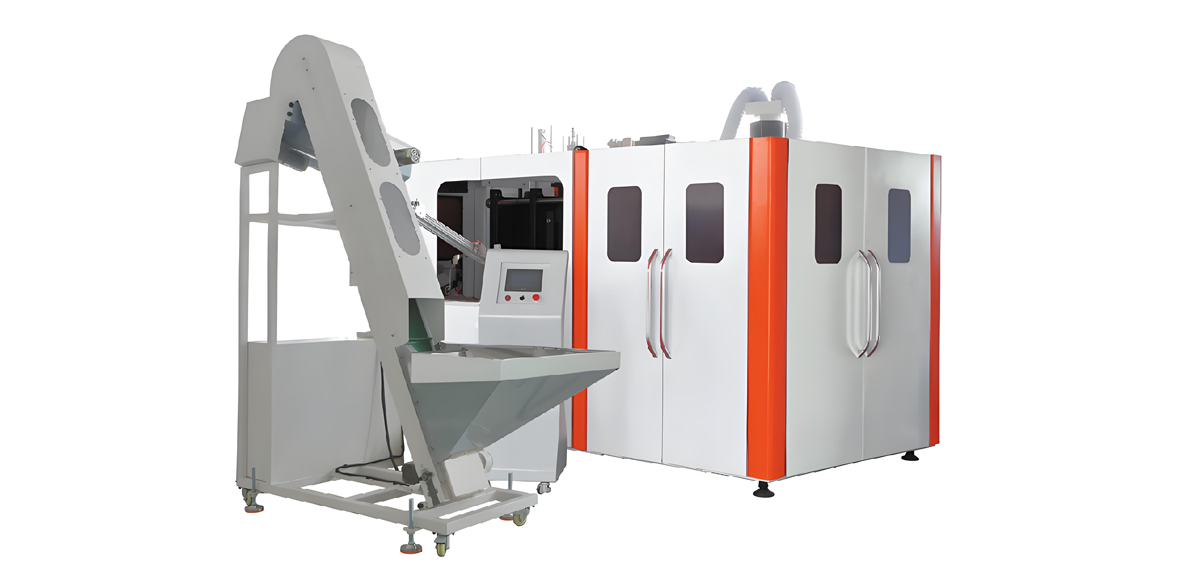
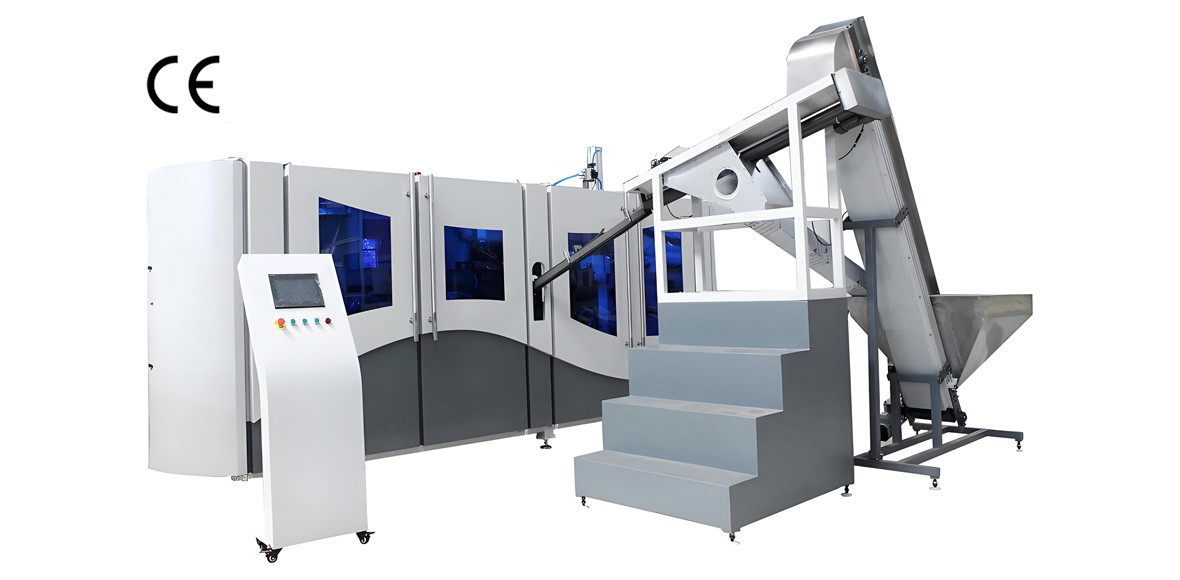
A fully automatic PET blow molding machine, whether linear or rotary, moves preforms from a feeding system into a multi-zone infrared heating oven, then into a blow station where servo-driven stretch rods and high-pressure valves do the work without human hands touching the preform during the cycle. Parameters such as oven zone temperatures, blow pressures, stretch rod positions, and timing are entered once, saved as a recipe, and reproduced thousands of times per hour. When a defect appears, the engineer does not grab a wrench; he opens the HMI, compares the live curve against the saved recipe, and adjusts a number.
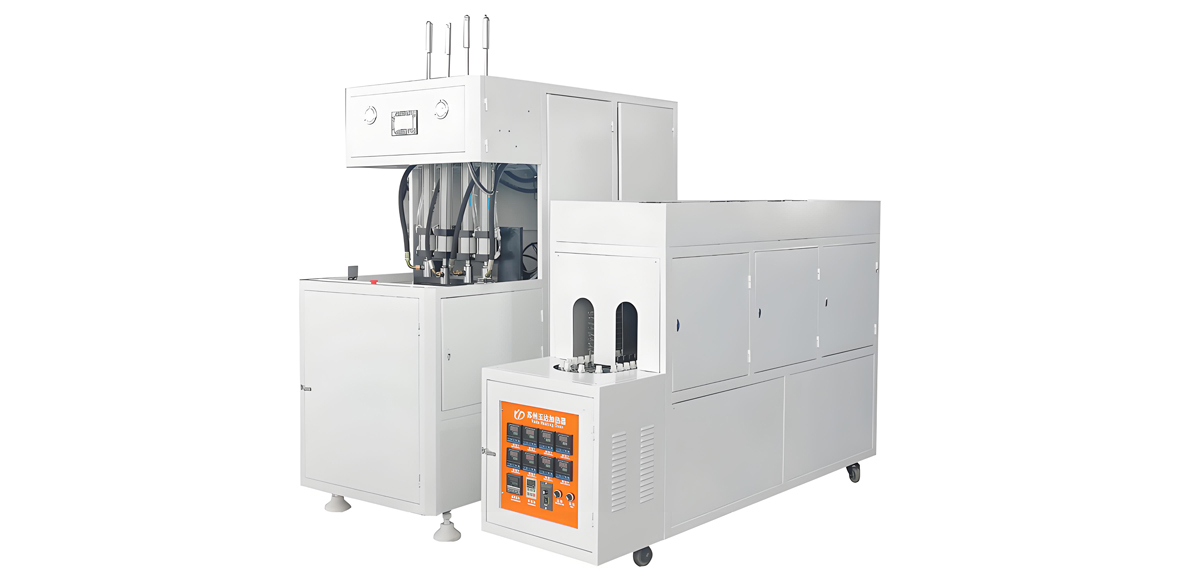
A semi-automatic machine works on a different rhythm. The operator loads a pre-warmed preform into the blow mold by hand, closes the mold, triggers the blow, and removes the finished bottle. There is often a separate preheating oven, and the operator reads the preform surface temperature by feel or with a handheld infrared gun. Pressure and timing are set with mechanical regulators and timer knobs. The “recipe” exists in the operator’s head and muscle memory rather than in a file. Debugging therefore means re-teaching the operator or re-setting the dials, and consistency depends on who is on shift.
| Aspect | Fully Automatic (Linear / Rotary, FGX class) | Semi-Automatic |
|---|---|---|
| Operator dependency | Low. One operator supervises several cavities and monitors the HMI. | High. One operator per station; output scales with labor. |
| Typical cavity count | 2 to 8+ cavities in a single blow station. | 1 to 2 cavities, manual loading. |
| Output range | 1,000 to 15,000 BPH depending on configuration. | Roughly 300 to 1,200 BPH per station. |
| Debugging method | Recipe-based, data-driven, saved and recalled from PLC. | Trial-and-error, skill-based, adjusted on the fly by hand. |
| Recipe management | Stored recipes per bottle SKU, cloneable across machines. | No electronic storage; relies on written notes or memory. |
| Heating control | Multi-zone infrared oven with closed-loop temperature. | Separate oven, manual setpoint, less uniform. |
| Parameter adjustment speed | Instant via HMI; changes apply to the whole run. | Slow; each dial affects one station at a time. |
| Cycle-to-cycle consistency | High and repeatable; ideal for brand-quality contracts. | Variable; depends on operator fatigue and skill. |
| Relative procurement cost | High (Premium class investment). | Low (entry-level investment). |
| Energy per bottle | Low; optimized ovens and servo recovery. | Medium to High; less oven efficiency. |
| Best use case | High-volume, multi-SKU, contract-grade production. | Pilot runs, low volume, startups, spare capacity. |
The philosophical divide matters for debugging because it changes where you look for the fault. On an automatic line, a defect almost always traces back to a recipe value, a sensor reading, or a mechanical wear item that the control system can report. On a semi-automatic line, the same defect may simply mean the operator loaded the preform a half-second late or set the regulator one turn off. The debugging toolkit is different, and so is the training you must invest in.
Anchor Machine: FGX Series High-Speed Fully Automatic Line
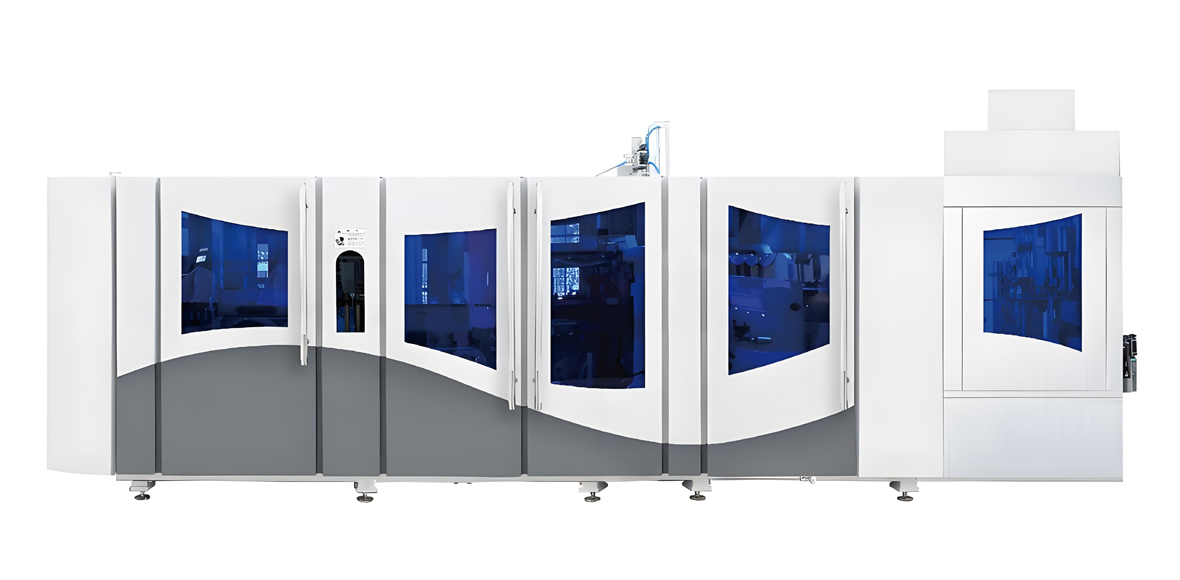
When the conversation turns to fully automatic, high-volume PET bottle production, YuDa’s FGX series is the workhorse we recommend most often. The FGX series sits in the high-speed band of 8,000 to 15,000 BPH and is built around a high-speed servo driving system paired with a unique cam linking system that integrates mold-opening, mold-locking, and bottom mold-elevating into a single synchronized movement. That mechanical integration is what lets the line hold tight cycle times without sacrificing bottle stability.
A defining feature of the FGX series is its energy-saving oven design. By minimizing the heater distance to 38.1 mm, the oven concentrates infrared energy on the preform and cuts electricity consumption by more than 30 percent compared with conventional heating ovens. For a plant running three shifts, that saving compounds into a meaningful reduction in cost per bottle, and it also reduces the heat load on the workshop. The line is modular, which keeps maintenance and mold changeovers cost-effective, and it relies on mature, stable component brands so that spare parts remain predictable over the machine’s service life.
Critically for formula debugging, the FGX series is built for remote monitoring. Engineers at the YuDa China headquarters can read the PLC data on a mobile device, observe abnormal trends, and feed corrections back to the client site. In practice this means a debugging session can happen with a Wanplas group application engineer looking at your live recipe from thousands of kilometers away, shortening the time between a defect appearing and a corrected parameter being applied.
| Specification | FGX Series (High-Speed Band) |
|---|---|
| Output range | 8,000 to 15,000 BPH depending on cavity configuration |
| Single-mode speed | 2,500 to 3,000 BPH per molding unit, scaled by cavity count |
| Drive system | High-speed servo with integrated cam linking (mold-open, mold-lock, base-elevate) |
| Heating oven | Multi-zone infrared, 38.1 mm heater distance, 30%+ electricity saving vs conventional ovens |
| Control | PLC with recipe management and HMI; multiple SKU recipes stored |
| Monitoring | Remote monitoring; PLC data viewable at China HQ via mobile |
| Design | Modular for convenient maintenance and fast changeovers |
| Components | Mature, stable component brands for long-term reliability |
| Relative investment | High (Premium class) |
For formula debugging, the FGX series shines because every parameter that matters is numeric, visible, and recordable. A production manager can run a water bottle recipe in the morning, switch to a carbonated drink bottle recipe at noon, and return to the water recipe in the afternoon without re-learning the machine. The recipe file carries the stretch ratio, blow pressure, preform temperature profile, and timing, so debugging becomes a comparison between the current run and the known-good baseline rather than a guess.
Anchor Machine: Semi-Automatic Line and the BFC CombiBlock
At the other end of the spectrum, YuDa’s semi-automatic PET blow machines are designed for lower procurement cost and are a natural fit for small enterprises, pilot projects, and operations that need a machine ready to ship and easy to learn. The debugging philosophy here is manual but forgiving: because the operator loads each preform, he can compensate for small variations in preform temperature by adjusting the timing of the trigger or the position of the preform in the mold. That human feedback loop is a feature when volumes are low and a liability when volumes are high.
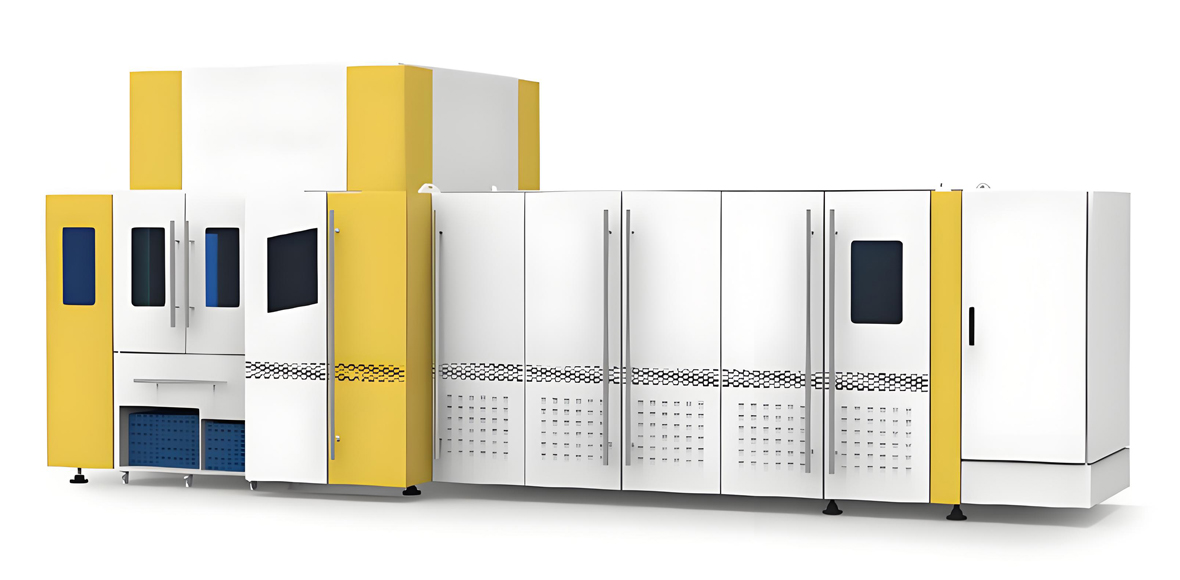
YuDa also builds integrated solutions that blur the line between blowing and filling. The linear blowing-filling-capping CombiBlock is a compact, simple, and easy-to-operate unit specialized in mini linear BFC, saving plant area by combining three operations in one footprint. The bottle blow-filling-capping (BFC) machine goes further: it produces PET bottles while filling drinking water and installs the bottle caps in a single process. For a plant that wants to minimize material handling and floor space, these integrated lines turn the debugging problem from “tune the blower, then tune the filler” into “tune one synchronized recipe.”
| Specification | BFC Bottle Blow-Fill-Cap Machine | Linear BFC CombiBlock |
|---|---|---|
| Process integration | Blow, fill, and cap in one process | Mini linear blow-fill-cap, compact layout |
| Primary product | PET water bottles with cap installed | PET bottles for drinking water, small footprint lines |
| Footprint benefit | Reduces separate filling line and transfers | Saves plant area; simple to operate |
| Debugging style | One synchronized recipe across blow and fill | Single compact recipe, fewer handoffs |
| Relative investment | Medium to High | Medium |
The BFC approach changes debugging because the blow and fill stations share a timing chain. A preform that is slightly over-stretched will not only look wrong as a bottle; it will also fill to the wrong level or seal poorly at the cap. Debugging therefore has to consider the whole synchronized sequence, which is exactly why YuDa engineers emphasize recipe management even on the integrated lines. When the blow and fill are one machine, the recipe is one data set, and that is far easier to stabilize than two independent machines talking across a conveyor.
Core Debugging Parameters: Temperature, Pressure, and Stretch Ratio
No matter which machine class you use, formula debugging comes down to a small set of parameters. Master these and you can correct almost every common PET bottle defect. The four heavyweights are preform temperature, blow pressure, stretch ratio, and timing. Below we give the typical window for each and explain what happens when you drift outside it.
Preform temperature. The preform wall should reach roughly 100 to 120 degrees Celsius at the moment of stretch. PET is amorphous after injection and becomes stretchable in this window; below it the material is too stiff and cracks or whitens under the stretch rod, and above it the material is too soft, loses orientation, and turns hazy or collapses. On a fully automatic line this temperature is the output of a closed-loop oven recipe; on a semi-automatic line it is the operator’s judgment of how long the preform sat in the preheater.
Blow pressure. The high-pressure blow that sets the final shape typically runs at 20 to 40 bar. Pre-blow, which begins the ballooning before the stretch rod finishes, runs lower, often in the 8 to 15 bar range. Too little pressure leaves the bottle short of the mold corners and with thick, uneven walls; too much can over-stress the oriented wall or burst a weakly oriented base. Carbonated drink bottles need the upper part of the range for pressure resistance.
Stretch ratio. The stretch rod pulls the preform axially while the blow expands it radially. A balanced bottle often uses an axial stretch ratio near 2:1 and a hoop (radial) stretch ratio of roughly 2.5:1 to 4:1, giving the biaxial orientation that delivers clarity and strength. If the axial ratio is too low, the base gets thick and the bottle feels heavy; if it is too high, the base center becomes thin and cracks. The relationship between the two ratios is the heart of formula debugging.
Timing. Stretch rod speed, blow delay, and pre-blow onset define when each action happens relative to mold close. A blow that fires too early wastes the stretch; one that fires too late fights a cooling preform. On automatic lines these are saved milliseconds in the recipe; on semi-automatic lines they are the operator’s trigger discipline.
| Parameter | Typical window | If too low | If too high | Common defect | Adjustment direction |
|---|---|---|---|---|---|
| Preform temperature | 100 to 120 deg C | Stiff, poor stretch | Soft, hazy, collapse | Whitening, base cracks | Raise oven zone setpoint or dwell |
| High blow pressure | 20 to 40 bar | Short fill, thick walls | Wall over-stress, burst | Corner short-shot, base burst | Raise for CSD, lower if base cracks |
| Pre-blow pressure | 8 to 15 bar | Late balloon, thin base | Early set, thick shoulder | Uneven shoulder wall | Tune with stretch timing |
| Axial stretch ratio | approx 2:1 | Thick, heavy base | Thin base center | Base crack, paneling | Adjust stretch rod final position |
| Hoop stretch ratio | 2.5:1 to 4:1 | Poor clarity, weak wall | Over-oriented, brittle | Haze, low top-load | Match preform length to mold |
| Blow delay | Tight after stretch | Preform cooling | Fights the stretch | Misshapen neck | Synchronize with rod travel |
| Mold cooling | Stable chilled water | Slow set, sticking | Over-cool, stress | Sticking, dimensional drift | Stabilize water temp and flow |
The practical lesson is that on a fully automatic line you apply this map by editing numbers in the recipe, and the change propagates to every cavity at once. On a semi-automatic line you apply the same map by re-setting regulator pressures, re-timing your trigger hand, and re-positioning the preform in the mold, one station at a time. The physics is the same; the execution speed and repeatability are not.
Preform Material and Its Process Window
Formula debugging cannot ignore the preform, because the preform’s PET grade and history set the boundaries of what any machine can achieve. The intrinsic viscosity (IV) of the PET, its drying and conditioning state, and whether it contains recycled content all shift the usable temperature and pressure window. A good debugging session starts by confirming the preform is within specification before blaming the machine.
Standard water bottle PET typically has an IV around 0.70 to 0.80 dl/g, which blow molds comfortably in the 100 to 120 degrees Celsius window. Carbonated soft drink bottles use a slightly higher IV, around 0.78 to 0.84 dl/g, to survive internal pressure, and they demand the upper part of the blow pressure range. Hot-fill bottles are often made from PET with a small copolymer or nucleating addition to withstand filling temperatures well above ambient, and they need a tuned process that preserves the heat-set structure. Recycled PET blends (rPET) introduce more variability in IV and contamination, so the oven profile usually needs a gentler, more even heating to avoid local overheating.
| Preform type | IV range (dl/g) | Blow temp window | Blow pressure need | Debugging note |
|---|---|---|---|---|
| Standard water bottle PET | 0.70 to 0.80 | 100 to 120 deg C | 20 to 30 bar | Baseline recipe; easiest to tune |
| Carbonated soft drink PET | 0.78 to 0.84 | 105 to 120 deg C | 30 to 40 bar | Hold orientation for pressure resistance |
| Hot-fill PET (copolymer) | 0.78 to 0.82 | 100 to 115 deg C | 25 to 35 bar | Preserve heat-set; watch paneling |
| rPET blend | 0.70 to 0.82 (variable) | 100 to 118 deg C, even | 25 to 38 bar | Even oven heating; watch haze |
| Lightweight preform | 0.72 to 0.80 | 102 to 118 deg C | 28 to 38 bar | Tight window; needs stable control |
This table matters for debugging because it tells you whether the problem is the machine or the material. If a hazy bottle appears only on a batch of rPET preforms, the fix is an oven profile change, not a pressure change. On a fully automatic line that change is a saved recipe variant; on a semi-automatic line it is a manual re-balance of the preheater. Either way, isolating material from machine is the first discipline of formula debugging.
Step-by-Step Debugging Workflow
A disciplined debugging workflow is what separates a line that reaches stable output in an hour from one that chases defects for a week. The sequence below works for both automatic and semi-automatic machines, with the execution tag indicating who performs each step.
Step 1 – Confirm the preform. Verify IV, drying, and neck finish. A wet or degraded preform will defeat any recipe. Execution: automatic line validates by incoming QC; semi-automatic line relies on operator inspection.
Step 2 – Load the base recipe. On the FGX series, recall the stored SKU recipe. On a semi-automatic line, set the regulator and timer to the written baseline for that preform. Execution: HMI vs manual dials.
Step 3 – Run a few cycles and observe. Look at wall distribution, base, shoulder, and neck. Do not change more than one parameter at a time. Execution: automatic line uses the live curve view; semi-automatic line uses the operator’s eye and a sample cut.
Step 4 – Isolate the defect with Table 4. Match the symptom to a parameter. If the base is thin and cracking, suspect axial stretch ratio or blow timing before touching pressure.
Step 5 – Make one change, re-run, record. On the automatic line, save the revised recipe with a version tag. On the semi-automatic line, write the new dial position and the time. Execution discipline is the difference-maker.
Step 6 – Lock and verify. Once the bottle passes top-load, drop-test, and visual checks, lock the recipe. On automatic lines, enable remote monitoring so the Wanplas group engineering team can verify stability. On semi-automatic lines, train the operator to the new baseline and post it at the station.
The contrast is clear: the automatic workflow is a data loop, while the semi-automatic workflow is a skill loop. Both can produce excellent bottles, but only the data loop scales across shifts and sites without re-training everyone.
Capacity-Based Model Selection
Choosing between automatic and semi-automatic is ultimately a capacity and business-model decision. The table below maps a target output to the YuDa line that fits it, so you can start debugging on the right machine from day one.
| Target output (BPH) | Recommended YuDa line | Why it fits |
|---|---|---|
| Below 1,000 | Semi-automatic PET blow machine | Lowest procurement cost; ready to ship; simple to learn |
| 1,000 to 7,000 | Standard Speed full automatic series | Advanced heating and energy-saving; recipe-managed |
| 8,000 to 15,000 | FGX series high-speed line | High-speed servo, cam linking, 38.1 mm oven; premium output |
| Blow + fill + cap in one | BFC machine or Linear BFC CombiBlock | Saves plant area; one synchronized recipe |
| Multi-SKU, contract grade | FGX series with recipe management | Stored recipes per SKU; remote monitoring support |
Notice that the decision is not “automatic is better.” For a startup validating a bottle shape, a semi-automatic machine lets you iterate cheaply and learn the recipe by hand. For a contract filler shipping millions of bottles a month, only the FGX series with stored recipes and remote monitoring will hold the line. The debugging skills transfer between them; the throughput and consistency do not.
Energy, Cost, and OEE Considerations in Formula Debugging
Formula debugging is not only a quality exercise; it is also a cost exercise. Every parameter you set on a PET blow molding line has a direct line to the cost per bottle, the energy per ton of throughput, and the overall equipment effectiveness (OEE) of the cell. Treating debugging as a financial lever, not just a defect-fixing task, is what separates a profitable line from a merely functional one.
Energy is the clearest example. The heating oven is the largest consumer on a blow molding line, and the preform temperature window of 100 to 120 degrees Celsius is where most of that energy is spent. A line with a wide, inefficient oven wastes electricity heating air instead of preforms, while a tightly tuned oven like the 38.1 mm heater-distance design on the FGX series concentrates infrared energy and cuts electricity by more than 30 percent compared with conventional ovens. During debugging, over-heating the preform to compensate for a different problem is a common mistake that quietly raises the energy bill without fixing the bottle. The disciplined approach is to set the lowest oven profile that still delivers good orientation, then solve the real defect elsewhere.
Blow pressure is the second cost lever. Running at 40 bar when 28 bar would satisfy the bottle spec wastes compressed air, and compressed air is one of the most expensive utilities in a bottling plant because of the power needed to generate it. Debugging should therefore aim for the minimum pressure that meets the top-load and pressure-resistance requirements, especially for still water bottles that do not need the upper end of the 20 to 40 bar window. On a fully automatic line this is a one-line recipe change; on a semi-automatic line it is a deliberate regulator setting the operator must be trained to respect rather than open up “just in case.”
OEE ties the two together with availability and quality. A line that stops every hour to re-tune a drifting recipe has poor availability, and a line that ships hazy or short-filled bottles has poor quality yield even if it runs fast. The debugging discipline of changing one parameter at a time, recording the result, and locking the recipe is exactly what protects OEE. On the FGX series, stored recipes and remote monitoring mean a drifting parameter is caught and corrected before it becomes downtime, which is why high-volume plants see OEE gains that justify the higher investment. On semi-automatic lines, the equivalent protection comes from operator training and a posted baseline, which is cheaper to install but harder to sustain across shifts.
From a total-cost view, the choice between automatic and semi-automatic is rarely about the purchase price alone. A semi-automatic machine has low procurement cost and low energy per unit of capital, but its labor dependency and variability cap both output and OEE. A fully automatic FGX line carries a premium investment and higher absolute energy use, yet its cost per bottle drops sharply as volume rises because labor and scrap fall. The right debugging mindset is to tune the recipe so that whichever machine you chose delivers the best cost per bottle at your actual production volume, rather than chasing the highest possible speed.
Application Industries and End Products
YuDa PET blow molding machines serve a wide set of packaging needs, and the debugging recipe changes with the end product. In the bottled water industry, the goal is lightweight clarity and low cost per bottle, so recipes favor efficient ovens and moderate blow pressure. In carbonated soft drinks, pressure resistance dominates, pushing blow pressure toward the upper window and demanding tighter orientation. Edible oil bottles need barrier-friendly wall distribution and good top-load for stacking. Household and personal care bottles often use colorful preforms and larger volumes, where neck quality and surface finish drive the recipe. Dairy and juice products, where filled cold or hot, call for heat-set or paneling-resistant process settings.
Across these industries the common thread is that the bottle’s job determines the formula. A water bottle optimized for weight will fail as a carbonated bottle if you only raise pressure; you must also re-balance the stretch ratio and timing. That is why YuDa, a Wanplas factory, ships each line with application know-how baked into the recommended starting recipes, and why the FGX series stores a recipe per SKU so a plant can move between water, CSD, and edible oil without reinventing the wheel. For plants that want to minimize logistics, the BFC and CombiBlock lines produce the bottle and fill it in one synchronized process, which is especially attractive for drinking water brands that value plant area and simplified sanitation.
Service and Support You Can Rely On
Formula debugging does not end at shipment. YuDa, as part of the Wanplas group, backs every machine with a service framework designed to keep recipes stable long after commissioning. Before a machine leaves the factory, it undergoes running tests so that the customer receives a line that has already proven its cycle. On-site installation and commissioning are performed by engineers who tune the first recipes with your actual preforms, not generic samples.
The Wanplas group policy includes USD 500 free parts every year, plus free replacement for damaged parts within the warranty period. Training is part of the handover: operators learn both the manual skill loop of a semi-automatic line and the data loop of an FGX series recipe system. Remote operation and maintenance are a standing capability, so the engineering team can review PLC data and guide a debugging session from the China headquarters. The open factory policy welcomes customers to visit, audit the production, and run their preforms on a live line before committing to a full order. This combination of testing, training, remote support, and transparent access is what lets a new recipe reach stable production instead of lingering as an unsolved defect.
Frequently Asked Questions
What exactly is “formula debugging” in PET blow molding?
Formula debugging is the practical process of setting and correcting the machine recipe, the combination of preform temperature, blow pressure, stretch ratio, and timing that turns a heated preform into a finished bottle. On automatic lines it means editing saved recipe values; on semi-automatic lines it means adjusting dials and trigger timing by hand. The aim in both cases is a clear, strong, dimensionally stable bottle.
Why does temperature matter more than people expect?
PET is only stretchable inside a narrow window, roughly 100 to 120 degrees Celsius at the preform wall. Below that the material cracks or whitens; above it the bottle loses orientation and turns hazy. Because the window is narrow, temperature control is usually the first thing to check when a defect appears, which is why automatic ovens use closed-loop zones and why semi-automatic operators watch preform heat so carefully.
Can a semi-automatic machine make the same quality bottle as a fully automatic one?
Yes, a skilled operator on a semi-automatic line can make an excellent bottle, sometimes indistinguishable from an automatic one. The difference is consistency and scale. The automatic line reproduces the recipe thousands of times per hour with low operator dependency, while the semi-automatic result varies with the operator’s skill and fatigue. For contract-grade, high-volume runs the automatic line is the safer choice.
How do I choose between the FGX series and a standard speed automatic line?
The deciding factor is output. The standard speed full automatic series covers roughly 1,000 to 7,000 BPH and is a strong fit for mid-volume plants. The FGX series covers 8,000 to 15,000 BPH with high-speed servo drive, cam linking, and the 38.1 mm energy-saving oven, suited to high-volume, multi-SKU operations. If your target is below 1,000 BPH, a semi-automatic machine is usually the most cost-effective start.
What should I do first when bottles come out hazy?
Check the preform temperature and material first. Haze usually means the preform was too hot, losing orientation, or that an rPET or copolymer preform needed a different oven profile. Confirm the preform IV and drying state, then lower the oven setpoint or re-balance the zones. Only after ruling out temperature and material should you look at blow pressure or stretch ratio.
Is remote monitoring really useful for debugging?
For automatic lines it is very useful. The FGX series lets engineers at the YuDa China headquarters read PLC data on a mobile device, spot abnormal trends, and feed corrections back to your site. That turns a local defect into a collaborative debugging session without waiting for an on-site visit, which shortens downtime and protects output.
How does a BFC line change the debugging approach?
A BFC or CombiBlock line combines blowing, filling, and capping into one synchronized recipe. A preform defect no longer stays in the bottle; it propagates to fill level and cap seal. Debugging therefore treats blow and fill as one sequence rather than two separate machines, which is simpler to stabilize once the single recipe is correct.
Do I need different recipes for water and carbonated bottles?
Yes. Water bottles are tuned for lightweight clarity at moderate pressure, while carbonated bottles need higher blow pressure and tighter orientation for pressure resistance. The FGX series stores a separate recipe per SKU, so switching between them is a menu selection rather than a re-tuning exercise. On semi-automatic lines the same change means re-setting the regulators and re-training the operator.
Conclusion
The difference between automatic and semi-automatic PET blow molding formula debugging is the difference between a data loop and a skill loop. Both aim at the same physics, a warm PET preform stretched biaxially and blown against a cooled mold, but they reach a stable recipe by different paths. Fully automatic lines such as YuDa’s FGX series store the recipe in the PLC, apply it consistently across thousands of bottles per hour, and let remote monitoring shorten debugging from days to hours. Semi-automatic lines put the recipe in the operator’s hands, offering low procurement cost and hands-on learning at the price of consistency and scale.
For most growing bottlers the practical path is to start where your volume is, learn the recipe discipline on the simpler machine, and step up to the FGX series or a BFC integrated line as output climbs. Whatever you choose, anchor your debugging on the same map: confirm the preform, set a baseline recipe, change one parameter at a time, and lock the result. YuDa, a Wanplas factory with more than 20 years of experience and 20-plus patents in PET bottle blow molding, builds both ends of this spectrum and supports them with testing, installation, training, USD 500 free parts per year, and remote engineering.
If you are planning a new line or troubleshooting an existing one, send us your bottle specification, target output, and preform details. Our application engineers will propose a configuration, share a starting recipe framework, and invite you to run your preforms on a live machine at our factory so you can see the debugging result before you buy.