Building a profitable PET bottle business does not require a mega-plant or a generic water-bottle line that competes on pennies per thousand bottles. The small factory that wins is the one that picks a defensible niche, configures a lean production cell, and reaches paying customers faster than large integrated suppliers can. This guide lays out a complete, physics-based roadmap for launching high-margin PET bottle production as a small-factory investment, using YuDa blow molding technology as the equipment backbone.
Small-Factory Positioning Logic
YuDa, a Wanplas factory, is one of the top two manufacturers of PET bottle blow molding machines in China, with more than 20 years of specialized experience, 20-plus patents, and equipment running in over 60 countries. That background matters for a small-factory investor because the right machine platform decides whether a modest production cell becomes a cash generator or a stranded asset. The strategic question is not “how cheap can I make a water bottle” but “which bottle categories let a small plant earn a durable margin without fighting scale players on generic volume.”
The answer is structural. Large integrated bottlers optimize for a narrow band of high-run, standardized containers, typically carbonated soft drink and plain water formats in the millions-of-bottles-per-month range. They achieve low unit cost through enormous throughput, centralized preform production, and locked-in filler contracts. A small factory cannot out-scale them on those terms. What a small factory can do is serve segments where flexibility, fast changeover, short lead time, and local responsiveness are worth more than the last percentage point of unit cost.
Three capabilities separate a winning small PET plant from a struggling one. The first is niche category focus: choosing bottle types with technical or service barriers that keep casual entrants out. The second is rapid changeover: the ability to switch molds and preform necks in minutes rather than shifts, so a 6,000-bottle order and a 40,000-bottle order are both profitable. The third is localized service: delivering to regional fillers, daily-chemical OEMs, and agrochemical packers who value a responsive neighbor over a distant mega-supplier. Together these let a small plant sustain gross margins in the 28 percent to 45 percent range on the right categories, compared with the thin single-digit-to-low-double-digit margins typical of undifferentiated water bottles sold into spot markets.
The trap that catches most first-time investors is the commodity water bottle. On paper it looks like the simplest product: one neck standard, one preform, enormous market. In practice it is the worst starting point for a small plant, because the buyers who purchase generic water bottles at scale are exactly the integrated mega-plants, and the spot market rewards only the lowest price per thousand. A small factory entering that race starts at a structural disadvantage in procurement, energy scale, and freight, and it usually loses. The profitable move is the opposite: serve categories where the bottle itself is part of the customer’s brand and where a short, reliable supply chain matters more than a marginal unit-cost edge. That is where a small, responsive plant wins repeat business and protects margin.
Throughout this article, capital intensity is expressed on an index-point basis rather than in currency. The entry-level single-machine project is set at 100 index points. Every other configuration is scored relative to that baseline so the investment logic is portable across regions and exchange rates. Margin potential is also expressed in index points relative to the same baseline, and risk levels use the plain scale Low, Medium, High, Very High, and Premium. This keeps the planning honest: the decision is about proportional structure, not about a number that changes with the next currency move.
Small-factory profitability in PET bottling is a positioning problem first and a cost problem second. Pick the right category, configure a lean cell, and the margin follows.
High-Margin Niche Category Matrix
The single most important planning step for a small PET bottle investor is category selection. Not all bottles are equal. The table below scores seven practical niche categories on technical barrier, equipment requirement, typical customer, relative margin potential (index points, baseline 100 = entry single-machine project), and order stability. These are the segments where a small plant with a YuDa blow molding line can realistically defend a margin.
| Niche Category | Technical Barrier | Equipment Requirement | Typical Customers | Margin Potential (index points) | Order Stability |
|---|---|---|---|---|---|
| Custom shaped daily-chemical bottles (hand soap, shampoo) | Medium-High: many molds, small batches, frequent changeover | Multi-cavity automatic or semi-auto with quick-change mold base | Daily-chemical OEMs, contract packers, private-label brands | 150 | Medium |
| Edible oil bottles (1 to 5 L, high stack load) | Medium: large volume, high top-load and stack strength | Stable large-cavity line, reinforced blow mold, neck handling | Regional edible oil packers, private-label food brands | 130 | High |
| Hot-fill bottles (crystallized neck, heat-resistant mold) | Very High: heat-set process, crystallized neck, tight tolerance | Heat-set capable blow unit, calibrated oven, precise cooling | Juice, tea, and functional-drink brands with hot-fill needs | 200 (Premium) | Medium-High |
| Agrochemical and industrial bottles (barrier, chemical resistance) | High: chemical resistance, certification, tamper features | Barrier-grade blow, controlled IV, robust mold and neck design | Agrochemical formulators, industrial chemical packers | 170 | Medium |
| Small premium bottles (cosmetic, oral liquid, appearance-critical) | High: surface finish, dimensional precision, visual quality | Precision blow with tight process window and clean handling | Cosmetic OEMs, pharmaceutical contract manufacturers | 185 | Medium |
| Wide-mouth jars and food jars (sauce, nuts, spreads) | Medium: special wide-neck mold and blow window | Wide-neck mold set, tuned stretch ratio, stable heating | Sauce and condiment packers, dried-food and nut producers | 140 | Medium-High |
| rPET eco bottles (brand ESG demand, blend-ratio process) | Medium-High: blend ratio control, haze and color management | Line tolerant of recycled content, process-stable heating | Brand owners with published sustainability commitments | 160 | Medium-High (growing) |
A few patterns stand out. Hot-fill bottles sit at the top of the margin scale at 200 index points because the heat-set process and crystallized neck demand a disciplined, repeatable blow window that casual shops cannot hold. Small premium cosmetic and oral-liquid bottles follow close behind at 185 index points, rewarded for appearance and precision rather than volume. Edible oil bottles offer the steadiest demand at the cost of a more moderate margin, which makes them an excellent anchor category that stabilizes the order book while higher-margin niches are developed.
For a first-time small-factory investor, the pragmatic path is to start with one anchor category plus one premium category. For example, an edible oil bottle line (stable, Medium margin) paired with a custom daily-chemical bottle line (Medium-High margin, Mold-heavy but flexible) builds a book that is both steady and profitable. Hot-fill and rPET can be added once the process team is mature enough to hold tight windows consistently.
Changeover discipline is the hidden driver behind this matrix. A plant that can swap a mold base and re-tune the oven in well under an hour turns the “small batch, frequent changeover” weakness of daily-chemical and cosmetic work into an advantage, because large plants avoid exactly those orders. Document the stretch ratio, oven lamp profile, and blow timing for every bottle in a reference library, and each subsequent order of that shape becomes a fast, low-risk re-run rather than a fresh development. Over a year, that compounding knowledge base is what separates a plant that merely runs machines from one that owns a defensible, high-margin book of niche accounts.
YuDa PET Blow Molding Lines for Starters
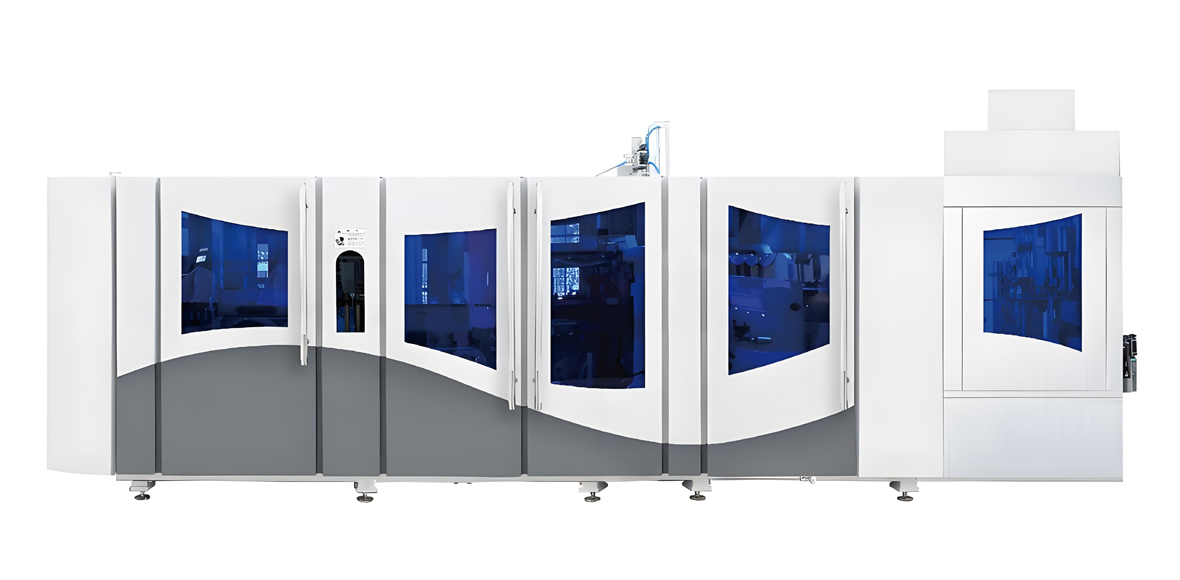
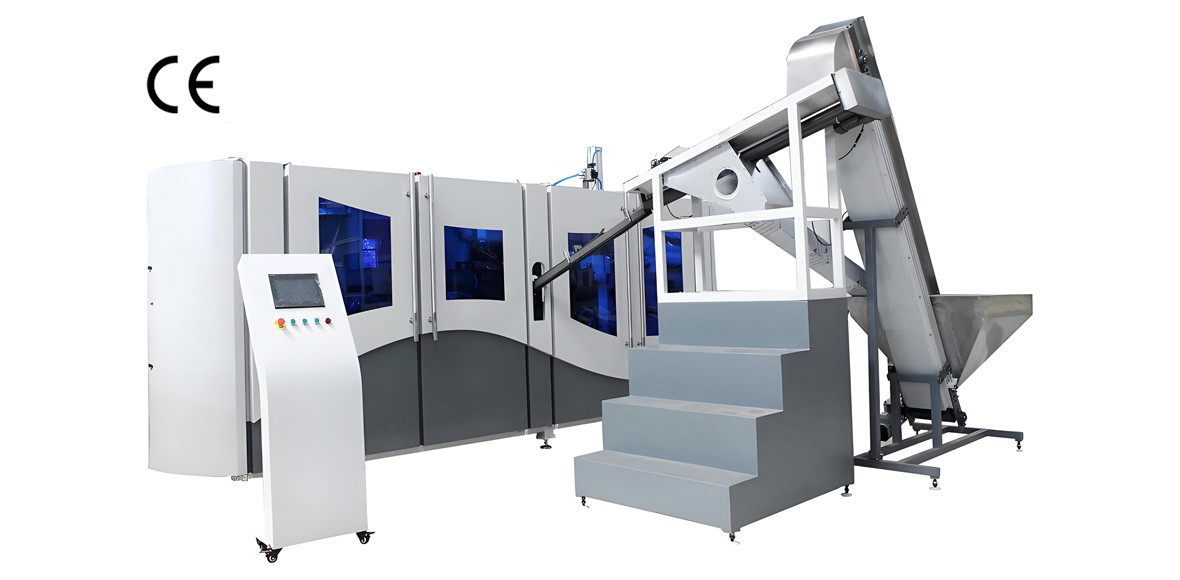
YuDa builds full-automatic and semi-automatic PET bottle blow molding machines across four practical families: the FGX High-Speed Series, the Standard-Speed Series, the Semi-Auto Series, and the integrated Blowing-Filling-Capping (BFC) combi units. For a small factory, the Semi-Auto Series and the FGX Series cover the entry and growth tiers almost completely, while the Linear BFC CombiBlock serves the advanced integrated tier. The technical highlights that matter for a lean plant are consistent across the range: a cam-linking system that combines mold-opening, mold-locking, and bottom-mold elevation in one motion, a high-speed servo drive, a remote monitoring system that lets engineers at the China headquarters read PLC data and flag anomalies, a modular design that speeds maintenance and mold changeover, and a 38.1 mm heater spacing that cuts electricity use by more than 30 percent versus conventional ovens.
YuDa FGX High-Speed Series (representative 6-cavity configuration)
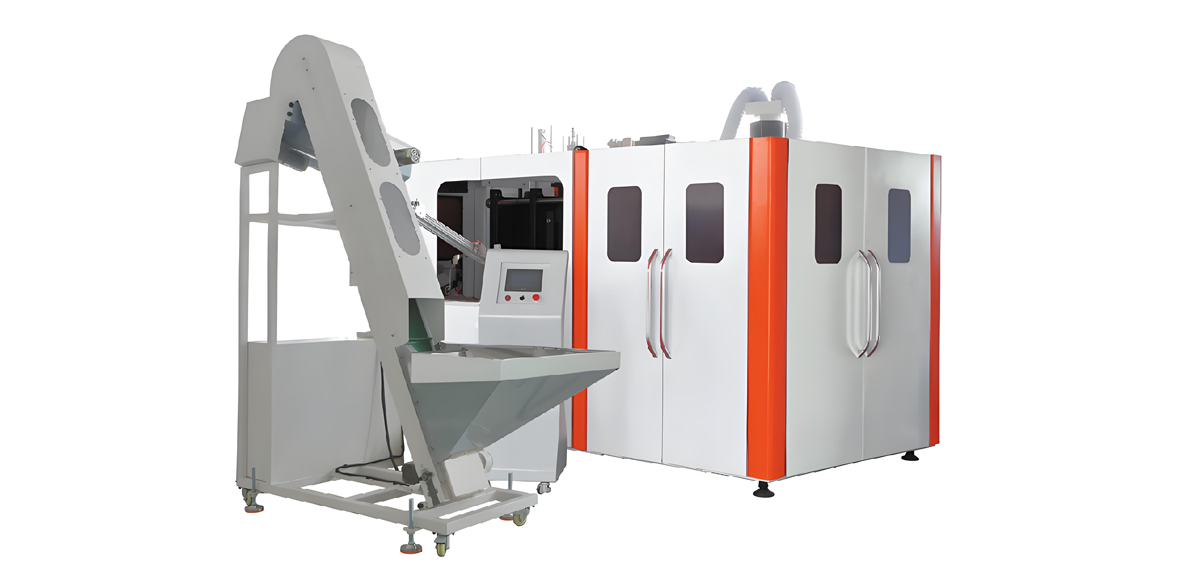
The FGX family is the high-speed backbone of the YuDa range, with single-mode speeds of 2,500 to 3,000 BPH and combined line output of 8,000 to 15,000 BPH depending on cavity count. A 6-cavity FGX is the natural growth-tier workhorse for a small plant moving beyond manual loading.
| Specification | FGX 6-Cavity (representative) |
|---|---|
| Cavity number | 6 |
| Theoretical capacity | Up to 12,000 BPH (within 8,000 to 15,000 BPH family range) |
| Bottle volume range | 0.2 to 2.0 L |
| Heating zones | 6 infrared oven modules with independent control |
| Blow pressure | Up to 3.0 MPa high-pressure stretch blow |
| Installed power | Approx. 48 kW (typical configuration) |
| High-pressure air consumption | Approx. 5.0 Nm³/min |
| Footprint (L x W x H) | Approx. 4,200 x 1,800 x 2,300 mm |
YuDa Semi-Auto Series (representative 2-cavity configuration)
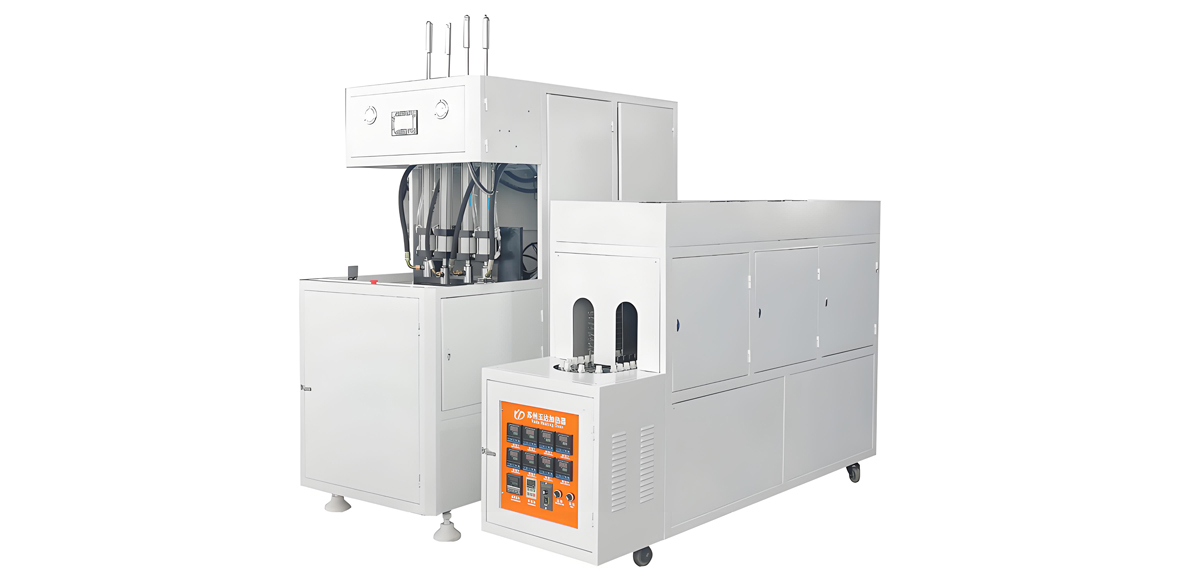
The Semi-Auto Series is the entry point for small enterprises. It carries a lower procurement cost, ships quickly, and pairs naturally with bought-in preforms, which is exactly the fastest way to start. It is also the ideal machine for Mold-heavy custom daily-chemical work where batch sizes are small and changeover frequency is high.
| Specification | Semi-Auto 2-Cavity (representative) |
|---|---|
| Cavity number | 2 |
| Theoretical capacity | 800 to 1,500 BPH |
| Bottle volume range | 0.1 to 2.0 L |
| Heating zones | 2 to 3 infrared oven modules |
| Blow pressure | Up to 3.0 MPa |
| Installed power | Approx. 8 kW (typical configuration) |
| High-pressure air consumption | Approx. 1.8 Nm³/min |
| Footprint (L x W x H) | Approx. 1,600 x 600 x 1,700 mm |
YuDa Linear BFC CombiBlock (representative 4-cavity configuration)
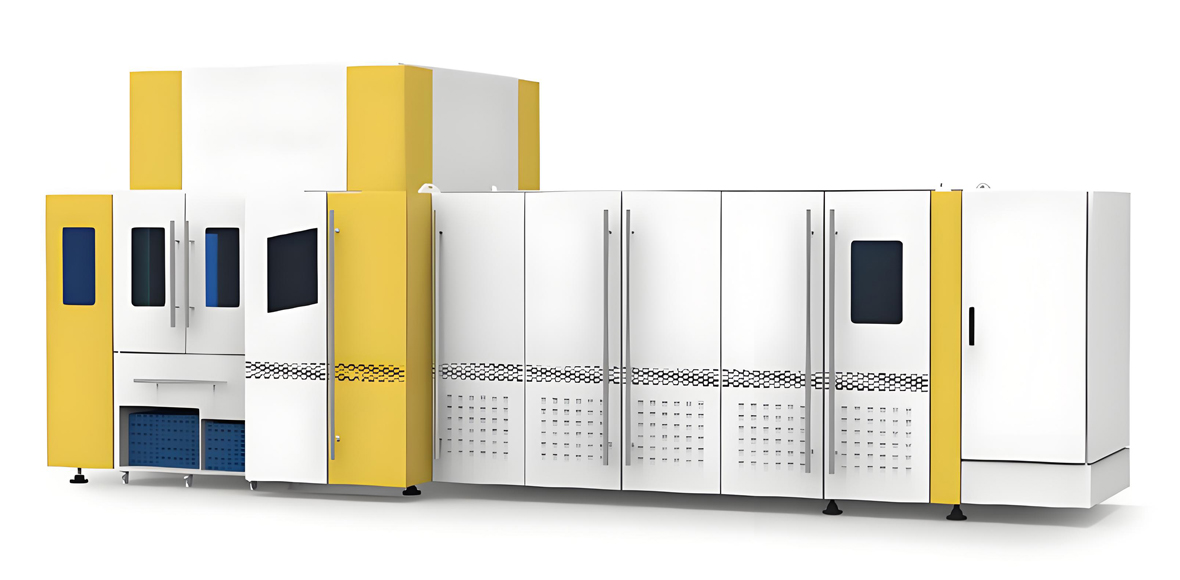
For the advanced tier, the Linear Blowing-Filling-Capping CombiBlock integrates blowing, filling, and capping in one compact, easy-to-operate unit. It is specialized in mini linear BFC layouts that save plant area and remove the air-conveyor interface between blowing and filling. The Bottle Blow-Filling-Capping (BFC) machine produces PET bottles while filling drinking water and installs caps in one continuous process.
| Specification | Linear BFC 4-Cavity (representative) |
|---|---|
| Cavity number | 4 |
| Theoretical capacity | 4,000 to 6,000 BPH (combined blow-fill-cap) |
| Bottle volume range | 0.2 to 1.5 L (water-grade) |
| Process integration | Blow, fill, cap in one frame |
| Blow pressure | Up to 3.0 MPa |
| Installed power | Approx. 40 kW (typical configuration) |
| Footprint (L x W x H) | Approx. 3,600 x 1,900 x 2,400 mm |
Wanplas, as the parent brand, can also supply matched downstream filling and packaging systems that integrate with YuDa blow molding lines when a project grows beyond blowing into a fully integrated line. That path keeps the small factory on a single, consistent technology and service relationship as it scales.
Three-Tier Starter Configuration Comparison
The capital intensity of a PET bottle project scales with automation and whether preforms are made in-house. The table below expresses three realistic starter configurations on the index-point scale where the entry single-machine project equals 100 index points. The growth configuration is about 1.8x the capital intensity of the entry configuration, and the advanced configuration is about 3.2x, reflecting added cavities, automation, and optionally in-house preform production.
| Parameter | Entry Tier | Growth Tier | Advanced Tier |
|---|---|---|---|
| Configuration | Semi-auto + bought preforms | Full-auto multi-cavity + auto loader + air conveyor | BFC combi / multi-line + self-made preforms |
| Capital intensity (index points) | 100 (baseline) | 180 (about 1.8x entry) | 320 (about 3.2x entry) |
| Output (BPH) | 800 to 1,500 | 4,000 to 9,000 | 9,000 to 15,000+ |
| Staffing (operators) | 2 to 3 | 3 to 5 | 6 to 10 |
| Floor area (㎡) | 60 to 90 | 150 to 250 | 350 to 600 |
| Power supply (kVA) | 15 to 25 | 60 to 100 | 150 to 250 |
| Air consumption (Nm³/min) | 1.5 to 2.5 | 4.0 to 7.0 | 8.0 to 14.0 |
| Best-fit niche | Custom daily-chem, sampling | Edible oil, agrochem, premium small | Hot-fill, rPET, integrated water |
The entry tier is the fastest route to a first paid order: a semi-auto machine, a pallet of preforms, and a compressor get a small plant producing sellable bottles within weeks. The growth tier is the inflection point where unit labor and energy per bottle fall sharply and the plant can serve regional fillers at meaningful volume. The advanced tier is only justified once a stable order book proves the categories, because the capital intensity and utility load are multiples of the entry point.
Make-or-Buy Preform Decision
Preforms are the raw input of every PET bottle. A small factory must decide early whether to buy preforms from a supplier or invest in injection and preform-making capacity. The decision is not about which is “better” in the abstract; it is about the output threshold at which self-production pays back its extra capital and complexity. The table below compares the two routes on an index-point and threshold basis, with no currency figures.
| Dimension | Buy Preforms | Make Preforms |
|---|---|---|
| Added capital intensity (index points) | 0 (baseline) | About 90 to 140 added points |
| Output threshold to justify | Always viable below ~6,000 BPH | Justified above ~6,000 to 8,000 BPH sustained |
| Flexibility | High: switch preform specs by purchase | Lower: tied to injection mold and resin setup |
| Quality control | Dependent on supplier; incoming inspection needed | Full control of IV, weight, neck, gate |
| Storage and drying | Minimal: handle finished preforms | Resin silo, dehumidifying dryer, crystallizer, warehousing |
| Material cost exposure | Carries supplier margin | Resin cost only, plus scrap recovery |
The practical rule for a small factory: buy preforms through the entry and most of the growth tier. Self-production only makes structural sense once sustained output crosses roughly 6,000 to 8,000 BPH and the plant can keep an injection line busy enough to absorb the drying, crystallizing, and warehousing overhead. Trying to make preforms too early is the most common way a small PET project ties up capital in the wrong place. Keep the bottleneck on blowing and selling, not on upstream resin handling.
Auxiliary Systems Checklist
A blow molding machine is only one node in a production cell. The supporting systems decide whether the line runs reliably and whether bottle quality stays inside tolerance. The checklist below covers the standard auxiliary package for a small plant, scaled to the tier chosen.
| System | Function | Specification Note |
|---|---|---|
| High-pressure air compressor | Supplies 3.0 to 4.0 MPa blow air for stretch blowing | Sized to Nm³/min of chosen tier; oil-free preferred |
| Low-pressure compressor | Controls, actuators, pneumatic handling | 0.7 to 1.0 MPa utility air |
| Air receiver and dryer | Stabilizes pressure, removes moisture | Buffers peak demand, protects valves |
| Chiller (water cooling) | Cools molds, compressor, hydraulic oil | Capacity scaled to installed kW |
| Dehumidifying dryer (if making preforms) | Dries PET resin to low moisture before injection | Required only for self-made preforms |
| Preform loader and sorter | Feeds preforms into oven automatically | Standard on full-auto tier |
| Air conveyor | Transfers blown bottles to filling or packing | Removes manual handling, protects necks |
| Blow mold set | Defines bottle shape, neck, base | Quick-change base speeds changeover |
| Inspection station | Wall thickness, leak, top-load, drop test | Manual at entry, automated at growth+ |
For the entry tier, the minimum viable package is a high-pressure compressor, a chiller, and a manual inspection bench. As the plant moves to the growth tier, automatic loading, air conveying, and at least a leak and top-load test become necessary to protect both throughput and customer quality agreements.
Site and Utility Requirements
A small PET bottle plant does not need a purpose-built facility, but the site must meet a few non-negotiable physical conditions. Floor area follows the tier table above: 60 to 90 ㎡ for entry, 150 to 250 ㎡ for growth, and 350 to 600 ㎡ for advanced, measured as production footprint and excluding separate warehousing. Ceiling height should allow at least 3.2 m to clear ovens, compressors, and any mezzanine loading. The floor must be flat, level, and able to carry compressor and chiller point loads, ideally with a sealed, easily cleaned surface.
Power supply scales from 15 to 25 kVA at entry, through 60 to 100 kVA at growth, to 150 to 250 kVA at advanced, and should be a stable three-phase supply with surge protection for the servo drives. A cooling-water loop (chiller plus buffer tank) is required; municipal or well water can supplement but should not be the sole source in warm months. For food-grade and pharmaceutical-adjacent bottles, a clean, controlled area is expected: GMP-aware housekeeping, separated raw and finished zones, pest control, and documented hygiene routines. Standards such as FDA, EU 10/2011, and GB contact regulations apply to the finished bottle depending on destination market, and they are met through material choice, process control, and supplier declarations rather than through the machine alone.
Ventilation and dust control matter more than many first-time investors expect. Infrared ovens and compressors reject heat; without extraction the cell warms and cycle stability suffers. Plan extraction and make space for preform and bottle quarantine areas so that incoming preforms and outgoing finished bottles never share a path.
Profit Model in Physical Quantities
Profit in PET bottling is best planned in physical units, not in currency. The model below uses output in thousands of bottles, utilization and good-rate percentages, energy per thousand bottles, labor hours per thousand bottles, material yield, gross-margin range, and payback in months. These are the levers a small-factory manager actually controls.
| Metric | Single Shift | Double Shift | Triple Shift |
|---|---|---|---|
| Annual operating days (typical) | 280 | 300 | 330 |
| Capacity utilization | 55 percent to 70 percent | 70 percent to 82 percent | 82 percent to 90 percent |
| Output (thousand bottles per year) | 1,300 to 2,400 | 3,000 to 5,200 | 5,500 to 9,000 |
| Good-rate (yield) target | 96 percent to 98 percent | 97 percent to 98.5 percent | 97.5 percent to 99 percent |
| Energy use (kWh per 1,000 bottles) | 28 to 38 | 20 to 28 | 16 to 22 |
| Labor (hours per 1,000 bottles) | 1.4 to 2.2 | 0.8 to 1.3 | 0.6 to 1.0 |
| Material yield (preform to bottle) | 98 percent to 99 percent | 98.5 percent to 99 percent | 99 percent+ |
| Gross margin range | 26 percent to 38 percent | 32 percent to 44 percent | 34 percent to 46 percent |
| Payback period | 16 to 24 months | 14 to 22 months | 13 to 20 months |
Two forces drive the margin. The first is utilization: moving from a single shift at 60 percent utilization to a double shift at 78 percent utilization typically lifts gross margin by 6 to 10 points simply because fixed overhead (rent, power standby, supervision) is spread over more bottles. The second is category mix: the same physical cell earns far more on a 185 index-point premium cosmetic bottle than on a commodity water bottle, which is why category selection precedes capacity expansion in priority.
Energy and labor per thousand bottles both fall as shift count rises, which is the structural reason multi-shift operation is more profitable than buying a bigger machine too early. A small plant should saturate its first cell across shifts before adding cavities. On the index-point scale, moving from the entry configuration (100 points) to the growth configuration (180 points) is justified only when the entry cell is consistently above roughly 80 percent utilization on a double shift.
Read the table as a system, not as isolated numbers. The good-rate target climbs with shift count because a settled process and a trained crew make fewer mistakes than a cold startup; protecting that good-rate is worth more than chasing raw speed, since every rejected bottle carries the same preform, energy, and labor cost as a good one. Material yield above 99 percent means almost no preform is wasted in blowing, which is achievable with stable neck transfer and correct stretch timing. The payback column tightens as utilization rises, which is the quantitative proof of the central thesis: fill the cell you have before buying the next one. A plant that treats utilization as the primary KPI will almost always out-earn a plant that treats machine count as the status symbol.
Customer Development Path
Equipment earns nothing until bottles are sold. The customer map for a small PET plant is local and relationship-driven. The strongest first accounts are regional fillers and contract packers who need a responsive bottle supplier and dislike the lead times of distant mega-plants. Daily-chemical OEMs and private-label manufacturers value small batches and fast mold changes, which play directly to a semi-auto or quick-change automatic cell. Agrochemical and industrial packers need barrier and certification discipline, a good fit once the process is documented. OEM and ODM labeling orders let the plant run steady volume under another brand’s spec.
The path from cold contact to repeat order runs through sampling and mold trial. A small factory should budget for a structured trial: receive the customer’s bottle drawing or sample, propose a preform and stretch ratio, blow a small batch, run leak and top-load checks, and ship samples in protective packaging. The mold trial is both a quality gate and a trust-building step; customers who see a disciplined trial process are far more likely to place recurring orders. Keeping a small library of proven mold bases shortens each new trial from days to hours.
Local presence is the unfair advantage. A small plant within a day’s drive of its customers can deliver emergency top-ups, attend quality reviews in person, and adapt to a customer’s seasonal spike. That responsiveness is worth more than a marginally lower unit price from a distant supplier, and it is the core of the small-factory margin thesis.
Building the trial library is the quiet work that pays off most. Each sampled order should leave behind a recorded specification: preform weight and neck, stretch-blow pressure, oven zone temperatures, cooling time, and the inspection results that the customer accepted. Over time this becomes a catalog of proven bottles that can be quoted and produced again in hours instead of days. It also de-risks the sales conversation, because a prospective customer can be shown a real, tested bottle rather than a promise. Plants that invest in this discipline convert references into referrals, and referrals are the lowest-cost, highest-trust channel a small bottle supplier has.
Risk and Mitigation
Every PET bottle project carries risks. The table below grades the common ones for a small factory and lists a practical mitigation for each. Risk levels use the plain Low, Medium, High scale.
| Risk | Level | Mitigation |
|---|---|---|
| Order seasonality | Medium | Mix anchor categories (edible oil) with premium niches; build off-season OEM accounts |
| Customer concentration | Medium-High | Cap any single account at a defined share of output; keep a pipeline of small accounts |
| Raw material (preform/resin) variability | Medium | Incoming IV and weight inspection; qualified supplier shortlist; buffer stock |
| Mold development lead time | Medium | Maintain quick-change mold bases; standardize necks; parallel trial scheduling |
| Quality claim from customer | Medium | Documented leak, top-load, drop, and wall-thickness checks; batch traceability |
| Certification barrier (food, pharma) | High for those markets | Confirm material declarations, GMP housekeeping, and standard compliance before entry |
The two risks that actually sink small PET projects are customer concentration and premature capacity expansion. Concentration is managed by discipline: no single account should dominate the order book, or a lost contract becomes a survival event. Premature expansion is managed by the utilization rule above; add cavities only after the first cell is saturated, not on a forecast.
12-Month Startup Roadmap
The roadmap below turns the plan into a sequence. It assumes an entry-tier start (100 index points) and a move toward the growth tier in the second year once demand is proven. Months are calendar months from decision to first repeat order.
| Month | Milestone | Key Action |
|---|---|---|
| 1 to 2 | Category selection | Choose one anchor plus one premium niche; define bottle specs and target customers |
| 3 | Validation | Run preform and blow trials; confirm leak, top-load, and visual quality windows |
| 4 to 5 | Equipment in place | Install semi-auto line, compressor, chiller; commission with YuDa support |
| 6 | Trial production | Produce sample batches; build inspection records and batch traceability |
| 7 to 8 | First customers | Deliver sampled orders; convert trials into recurring contracts |
| 9 to 10 | Stabilize | Hold good-rate above 97 percent; move toward double-shift on proven categories |
| 11 to 12 | Expand | If utilization stays above 80 percent on double shift, plan growth-tier upgrade |
This sequence is deliberately conservative. It spends the first third of the year proving the category and the process before committing to volume. That discipline is what keeps the capital intensity at the entry baseline until revenue is real, which is the safest way to protect the margin thesis.
Model Selection Guide
The table below maps a typical small-factory requirement to a recommended YuDa model. It is the fastest way to turn the planning above into a concrete machine choice.
| Requirement (output / bottle type / budget level) | Recommended YuDa Model |
|---|---|
| Entry, custom daily-chem, Low budget | YuDa Semi-Auto Series (2-cavity) |
| Growth, edible oil 1 to 5 L, Medium budget | YuDa FGX Series (4 to 6-cavity) |
| Growth, premium small cosmetic, Medium budget | YuDa FGX Series (4-cavity precision) |
| Advanced, hot-fill heat-set, High budget | YuDa FGX Series with heat-set oven option |
| Advanced, integrated water, High budget | YuDa Linear BFC CombiBlock (4-cavity) |
| Advanced, rPET eco bottles, High budget | YuDa FGX Series (recycled-content tolerant) |
Service and Support
YuDa, as a Wanplas factory, backs its machines with a service package built for small-factory operators who cannot afford long downtime. Before shipment, every line is run and tested so that commissioning on site is a confirmation, not a discovery. Engineers support installation and commissioning, either on site or through the remote monitoring system that reads PLC data from the China headquarters and flags anomalies to the customer’s team. The shared Wanplas group policy includes USD 500 free parts per year, free replacement of damaged parts within warranty, an open-factory invitation for any buyer to audit the plant before ordering, operator training on running and basic maintenance, and remote operation support for process tuning.
For a first-time investor, the open-factory policy is more than a courtesy; it is a way to verify build quality, inspect the cam-linking servo mechanism, and confirm the 38.1 mm heater spacing that delivers the 30 percent-plus energy saving before committing capital. Training covers mold changeover, oven setting, stretch-blow pressure tuning, and the daily inspection routine that protects good-rate. Together these supports shorten the time from machine arrival to stable, sellable output.
Frequently Asked Questions
What is the cheapest way for a small factory to start PET bottle production?
The lowest-capital route is a semi-auto YuDa blow molding machine paired with bought-in preforms and a high-pressure compressor. On the index-point scale this entry configuration is set at 100 points, and it lets a small plant deliver its first sampled bottles within weeks without investing in preform injection. It is the right starting point for custom daily-chemical work and for proving a customer before scaling.
How many bottles per hour can a small YuDa line produce?
It depends on the tier. The Semi-Auto Series typically runs 800 to 1,500 BPH, the FGX High-Speed Series reaches 8,000 to 15,000 BPH in multi-cavity form, and the Linear BFC CombiBlock integrates blow-fill-cap at 4,000 to 6,000 BPH for a 4-cavity unit. A small factory usually begins near the lower end and grows cavities as utilization proves out.
Should a small factory make its own preforms or buy them?
For most small plants, buying preforms is correct through the entry and growth tiers. Self-production only earns its extra capital and drying, crystallizing, and warehousing overhead once sustained output crosses roughly 6,000 to 8,000 BPH. Making preforms too early ties up capital that is better spent on blowing and selling.
Which PET bottle categories give the highest margin for a small plant?
On the index-point scale, hot-fill heat-set bottles score highest at about 200 points, followed by small premium cosmetic and oral-liquid bottles near 185 points and agrochemical or industrial bottles near 170 points. Edible oil bottles offer lower but steadier margin and make a strong anchor category. The right mix is one stable anchor plus one premium niche.
How long does a PET bottle project take to pay back?
Using physical planning rather than currency, a well-run small cell typically reaches payback in 13 to 24 months depending on shift count and utilization. Single shift at modest utilization trends toward 16 to 24 months, while a saturated double shift often pays back in 14 to 22 months. The key is reaching high utilization before adding capacity.
What utilities does a PET blow molding cell require?
The cell needs a stable three-phase power supply sized from 15 to 25 kVA at entry up to 150 to 250 kVA at advanced tier, a cooling-water loop through a chiller, high-pressure air at 3.0 to 4.0 MPa for blowing plus low-pressure utility air, and a clean, ventilated space with separated raw and finished zones for food-grade work. Ceiling height of at least 3.2 m supports ovens and compressors.
Can YuDa machines handle rPET or recycled-content bottles?
Yes. The FGX Series can be configured to tolerate recycled content with a stable heating profile and blend-ratio control, which supports brand-owner ESG programs. The process window for rPET is tighter on haze and color, so it fits best once the plant’s process discipline is mature and inspection is documented.
What after-sales support does YuDa provide to small factories?
Support includes pre-shipment testing, installation and commissioning, remote PLC monitoring from the China headquarters, operator training, the Wanplas group policy of USD 500 free parts per year, warranty replacement of damaged parts, and an open-factory invitation for pre-order audits. This package is designed to minimize downtime for plants without a large in-house maintenance team.
Conclusion
A high-profit PET bottle project for a small factory is a positioning decision first. Choose a defensible niche, configure a lean cell that starts at the 100 index-point entry baseline, and grow cavities only after utilization proves the demand. YuDa, a Wanplas factory with more than 20 years of PET blow molding specialization, 20-plus patents, and equipment in over 60 countries, provides the full path from the Semi-Auto Series through the FGX High-Speed Series to the integrated Linear BFC CombiBlock, with the cam-linking servo system, 38.1 mm energy-saving heater spacing, and remote monitoring that keep a small plant competitive.
The roadmap is straightforward: select one anchor and one premium category, validate the blow window, install and commission the entry line, convert trials into recurring customers, and expand only on proven utilization. If you are evaluating a PET bottle venture, send your target bottle specifications and expected monthly volume, and the YuDa team will propose a tailored configuration, arrange an open-factory visit, and support a sample trial so you can verify quality before committing capital.