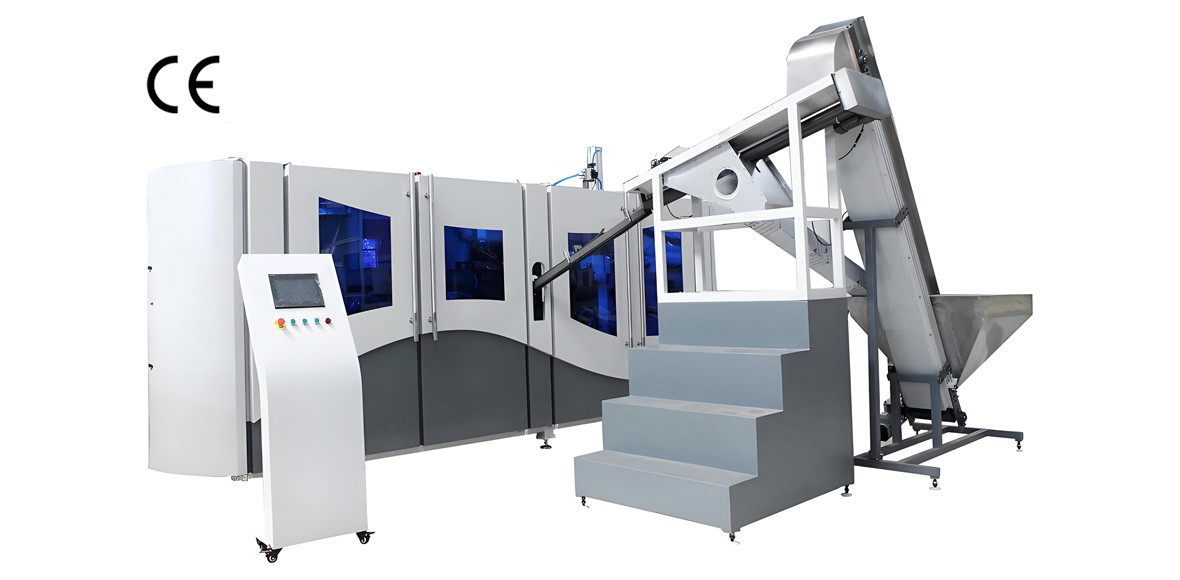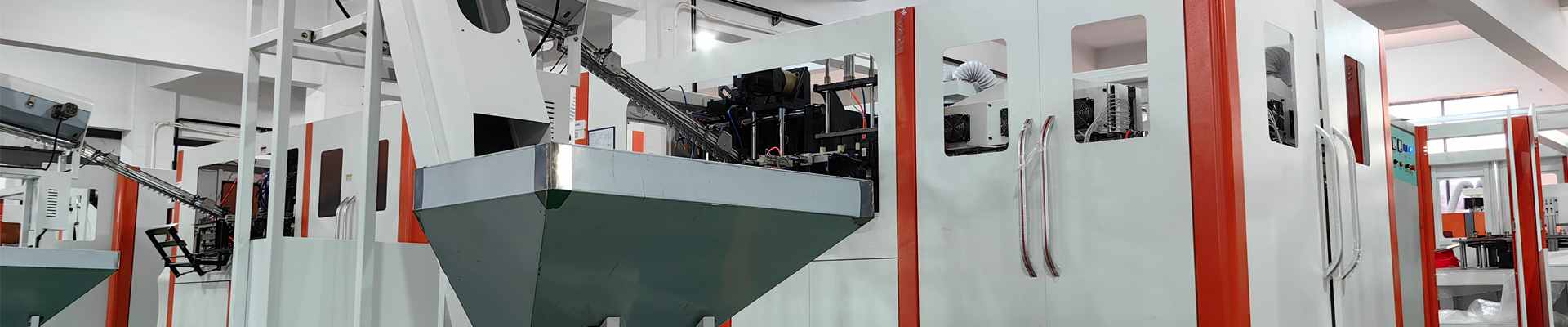
Complete Machine List for Carbonated Drink PET Bottle Production Plant
Building a carbonated drink PET bottle production plant is fundamentally different from building a still water line, and the machine list is where that difference first becomes visible. A carbonated soft drink holds between 3.5 and 4.5 volumes of dissolved carbon dioxide, which means the finished bottle must contain an internal pressure that can reach 5 to 6 bar when the product warms to 38 degrees Celsius during transport or warehouse storage. Every machine downstream of the resin hopper is sized around that single physical fact: the preform is heavier, the stretch ratios are tighter, the blow pressure is higher, the base geometry is a five-footed petaloid instead of a flat or champagne profile, the filler must work under counter-pressure rather than gravity, and the packaging section must handle a container that is permanently trying to expand. YuDa Machinery, a Wanplas factory with more than twenty years of dedicated experience in PET bottle blow molding machines, exports to over sixty countries and holds more than twenty patents in reheat stretch blow molding, and the equipment list below reflects how those lines are actually configured in the field rather than a generic catalog listing.
The plant is best understood as six connected blocks: water treatment, syrup preparation, carbonation and carbon dioxide supply, bottle blowing, isobaric filling and capping, and downstream packaging. Each block has its own critical machine and its own set of auxiliary units that quietly determine whether the headline output figure is ever reached. Investors frequently budget carefully for the blow molding machine and the filler, then discover that an undersized high-pressure air compressor, a chiller without enough reserve capacity for a summer ambient of 40 degrees Celsius, or a deaerator that cannot pull dissolved oxygen low enough will cap the whole plant at seventy percent of nameplate output. The sections that follow walk through every machine in sequence, give the sizing logic and the parameter windows an engineer needs to specify each one, and identify where a small change in specification produces a large change in bottle quality, energy consumption, or changeover time.
Why Carbonated Bottles Change Every Machine Specification
Pressure resistance in a PET bottle is not created by adding material; it is created by orientation. When a reheated preform is stretched axially by the stretch rod and then expanded circumferentially by high-pressure air, the amorphous polymer chains align into a biaxially oriented structure with strain-induced crystallinity, and it is that oriented wall which resists creep. For still water the planar stretch ratio, meaning the axial ratio multiplied by the hoop ratio, is usually held between 8 and 10. For carbonated drinks the same calculation is pushed to between 10 and 14, with an axial ratio of roughly 2.5 to 3.0 and a hoop ratio of 3.5 to 4.5, because the higher degree of orientation is what delivers stress cracking resistance and low volumetric creep. Achieving those numbers requires a preform designed specifically for the bottle rather than a general purpose preform, and it requires an oven and mold combination that can hold the body temperature window tightly, typically 95 to 115 degrees Celsius measured on the preform surface at the exit of the equalization zone, with the neck finish actively cooled so the thread and support ring remain dimensionally stable.
Resin selection follows the same logic. Carbonated applications normally call for bottle grade PET with an intrinsic viscosity of 0.80 to 0.84 deciliters per gram, higher than the 0.76 to 0.80 range common for water, because the longer chains improve melt strength during injection of the preform and improve creep resistance in the finished container. Preform gram weight rises sharply as well. A 500 milliliter still water bottle can be produced at 12 to 15 grams, while the same volume in a carbonated version needs 22 to 28 grams; a 1.5 liter carbonated bottle typically sits between 38 and 45 grams and a 2 liter between 48 and 54 grams. The neck finish is almost always a 28 millimeter carbonated profile, either the taller conventional version or the short version that saves roughly one gram of resin per bottle, and both must be matched by the capper, the cap feeder, and the blow mold neck insert. If preforms are injection molded in-house rather than purchased, add a dehumidifying dryer capable of holding resin moisture below 50 parts per million at 160 to 170 degrees Celsius with four to six hours of residence time, because hydrolytic degradation during injection permanently lowers the intrinsic viscosity and with it the pressure performance of every bottle produced that shift.
The Complete Machine List at a Glance
The table below groups the plant into its six functional blocks with the core machines in each. It is deliberately compact; the paragraphs that follow expand each block with sizing figures, parameter windows, and the auxiliary units that do not appear in a summary but must appear in a purchase order. Read the list as a dependency chain rather than a shopping list, because the sequence matters: water quality sets the ceiling on product taste, syrup accuracy sets the ceiling on Brix consistency, carbonation temperature sets the ceiling on achievable gas volumes, bottle orientation sets the ceiling on shelf life, and filler counter-pressure sets the ceiling on line speed.
| Block | Core Machines | Function |
|---|---|---|
| Water room | Multimedia filter, carbon filter, softener, reverse osmosis, ultraviolet unit | Produce treated process water |
| Syrup room | Sugar dissolver, plate heat exchanger, double filter, batching tank | Prepare and store finished syrup |
| Carbonation | Deaerator, in-line blender, carbonator, carbon dioxide vaporizer | Blend and charge gas |
| Blowing | Preform loader, reheat stretch blow molding machine, chiller, high-pressure compressor | Form pressure-rated bottles |
| Filling | Isobaric rotary filler, capper, cap feeder and sterilizer | Fill and seal under pressure |
| Packaging | Bottle warmer, labeler, coder, inspector, shrink wrapper, palletizer | Finish, inspect, and palletize |
Two machines are absent from that summary on purpose. The first is the preform injection molding machine with its preform mold, chiller, and dryer, which belongs in the list only if the plant chooses to make preforms rather than buy them; most new carbonated plants buy preforms for the first two or three years because preform injection is a separate discipline with its own tooling economics and its own quality control burden. The second is the clean-in-place system, which is not optional at all but which serves the water room, syrup room, carbonation skid, and filler simultaneously and therefore does not sit inside any single block. A carbonated line also needs an empty bottle air rinser rather than a full water rinser in many configurations, since blown bottles arriving directly from the blow molding machine through an enclosed air conveyor are far cleaner than bottles that have been stored and transported.
Water Treatment and the Syrup Room
Process water for a carbonated drink has to be more than potable. Residual alkalinity neutralizes the acid in the beverage and shifts the taste profile, chlorine and chloramine attack flavor compounds, iron and manganese cause discoloration, and any suspended solid becomes a nucleation site that makes the product foam uncontrollably at the filler. A conventional train starts with a multimedia sand filter to remove particulates above roughly 20 micrometers, moves to an activated carbon filter with an empty bed contact time of at least ten minutes to strip free chlorine and organics, then to a softener or a reverse osmosis unit depending on the raw water hardness and total dissolved solids, and finishes with a 0.2 micrometer microfiltration cartridge and an ultraviolet sterilizer sized for at least 30 millijoules per square centimeter. Alkalinity below 50 parts per million as calcium carbonate and total dissolved solids in the 50 to 250 parts per million range are typical targets for carbonated products. Size the train for at least 1.3 times the peak line demand, because a 12,000 bottle per hour line running 500 milliliter bottles consumes about 6 cubic meters of product water per hour plus rinse and clean-in-place demand, and a water room running at its absolute limit has no capacity left for the regeneration cycles it needs.
The syrup room converts sugar, acid, flavor, and color into a stable concentrate at a controlled Brix. Hot dissolution at 80 to 85 degrees Celsius with subsequent cooling through a plate heat exchanger to 20 to 25 degrees Celsius is the conservative choice because it inverts a controlled fraction of the sucrose and reduces microbiological risk, while cold dissolution with a high-shear mixer saves energy and suits plants using liquid sugar or high-intensity sweeteners. A complete room comprises a sugar dissolving tank with agitator, a plate heat exchanger, a double bag or candle filter, at least two batching tanks so one can be mixed while the other feeds the line, a finished syrup storage tank sized for one to two hours of production, and dosing pumps with in-line Brix and conductivity measurement. Accuracy matters more than capacity here: a deviation of 0.1 degrees Brix in the finished beverage is detectable by trained panels and can push a product outside its declared nutritional values, so the metering pumps and the blender that follows must be specified with repeatability in mind rather than throughput alone.
Carbonation, Blending, and Carbon Dioxide Supply
Carbon dioxide solubility in water rises as temperature falls and as pressure rises, which is why every carbonation skid is also a refrigeration problem. Product is normally cooled to 2 to 6 degrees Celsius before gas is injected, because at 4 degrees Celsius and 4 bar the water will hold roughly 4 volumes of gas in stable solution, whereas at 20 degrees Celsius the same pressure holds barely half that. Dissolved oxygen competes for the same physical space and destabilizes the carbonation, so a vacuum or column deaerator that pulls dissolved oxygen below 0.5 parts per million sits upstream of the gas injection point. The modern arrangement is an in-line blender that meters treated water and syrup volumetrically against a mass flow or magnetic flow measurement, checks the resulting Brix in-line, and then injects carbon dioxide through a sparger or a packed column, all inside one skid with its own control panel. The older batch carbonator with a separate premix tank is still perfectly workable for lines below 6,000 bottles per hour and costs less to buy, but it is slower to change over between products and less accurate on Brix.
The gas supply itself is a machine list item that new plants often underestimate. Beverage grade carbon dioxide at 99.9 percent purity is delivered as a liquid and stored in an insulated tank at roughly 18 to 20 bar, from which an ambient or electric vaporizer converts it to gas at the flow rate the carbonator demands, followed by a pressure regulating station and a final gas filter. Consumption runs between 5 and 7 kilograms per 1,000 liters of finished carbonated product once vent losses, filler counter-pressure purging, and clean-in-place displacement are included, which is meaningfully higher than the theoretical dissolution figure alone. Undersizing the vaporizer produces a symptom that looks like a carbonation fault but is actually a supply fault: gas volumes drift downward whenever the line runs at full speed for more than twenty minutes, and the operator chases the carbonator set points instead of the frost line on the vaporizer.
Blow Molding: The Core Machine of the Plant
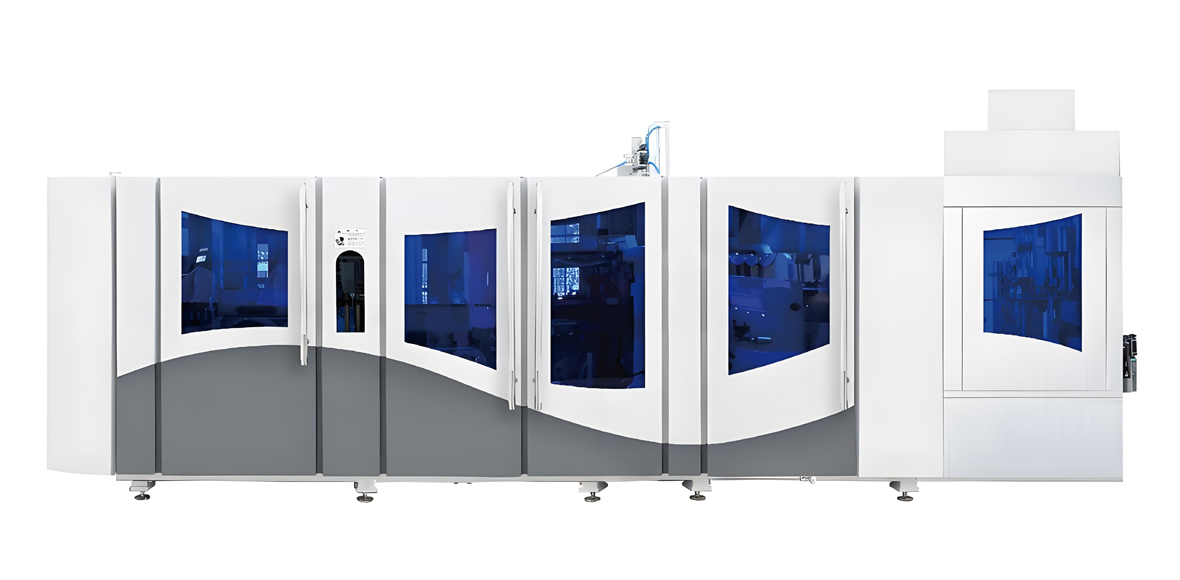
The reheat stretch blow molding machine, working on the two-step process, is where a purchased or in-house preform becomes a pressure vessel. Preforms are elevated by a hopper loader, singulated and oriented by a rotary or roller sorter, hung on a neck-support chain by their support rings, and carried through an infrared oven built from banks of quartz lamps arranged in zones, with the preform rotating continuously so heat distributes evenly around the circumference. Lamp power distribution across the zones is the main tool for shaping the axial temperature profile, and it is what allows a thick-walled carbonated preform to reach a uniform body temperature without overheating its outer skin. YuDa reduces the distance between the heating lamps and the preform surface to 38.1 millimeters, which raises radiation efficiency and cuts oven electricity consumption by more than thirty percent compared with conventional wide-gap ovens; since the oven typically accounts for sixty to seventy percent of the total power draw of the blowing block, that single design decision dominates the energy line of the operating budget. Neck cooling plates and forced air keep the finish below the temperature at which the thread deforms, and an equalization section after the last lamp bank lets heat conduct inward so the wall is uniform through its thickness rather than merely hot on the surface.
In the blowing station the preform is clamped, the stretch rod descends under servo control, pre-blow air at 8 to 12 bar begins the radial expansion while the rod is still traveling, and final blow air at 35 to 40 bar completes the forming and presses the wall against the mold surface. Carbonated bottles sit at the top of that pressure range because the petaloid base needs high pressure to form its feet fully and to avoid thin webs between them. Mold cooling water at 8 to 12 degrees Celsius circulates through the body halves while the base mold is often held two to four degrees colder, since the base is the thickest and slowest-crystallizing region and also the region where stress cracking failures begin. YuDa applies a cam linking system that combines mold opening, mold locking, and base mold elevation into a single coordinated movement driven by a high-speed servo system, which shortens the dead time between cycles and improves repeatability of the clamping force; a modularized machine layout then keeps mold changes and maintenance quick, which matters on a carbonated line running three or four bottle formats. A blow air recovery circuit that captures the exhaust from the final blow and returns it to the low-pressure network or to the pre-blow stage reduces high-pressure air consumption by thirty to forty percent and pays for itself faster than almost any other option on the machine.
| YuDa FGX Configuration | Cavities | Output (BPH) | Max Volume |
|---|---|---|---|
| FGX high speed | 3 | 8,000 – 9,000 | 600 ml |
| FGX high speed | 4 | 10,000 – 12,000 | 600 ml |
| FGX high speed | 5 | 12,500 – 15,000 | 600 ml |
| FGX high speed | 6 | 15,000 | 500 ml |
| FGX large format | 4 | 7,000 – 8,000 | 2,000 ml |
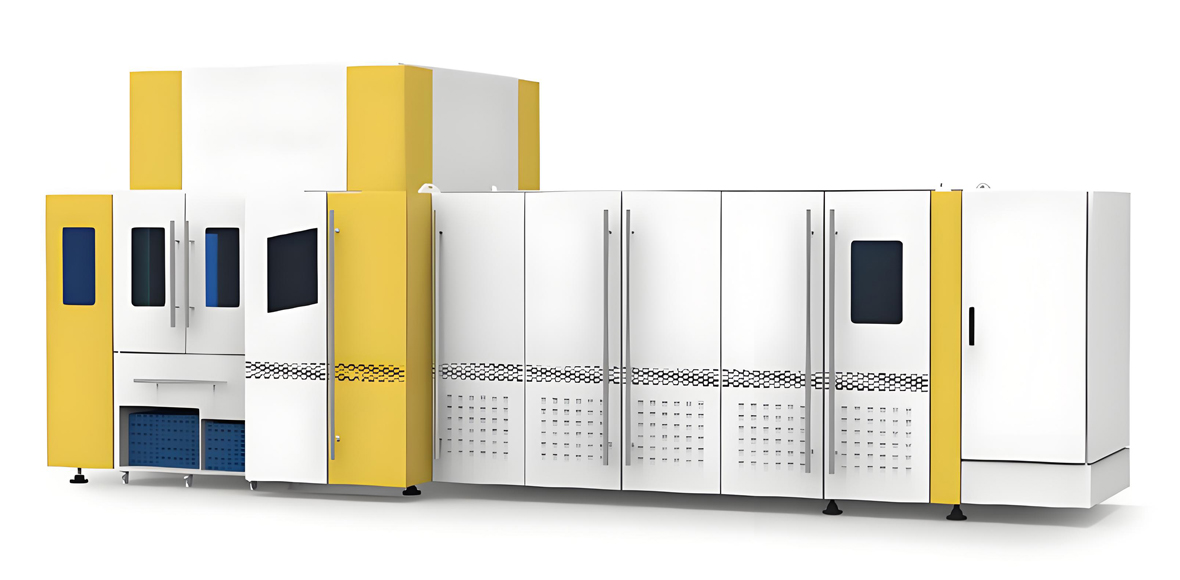
The FGX series is the high-speed platform, covering 8,000 to 15,000 bottles per hour with a single-mold speed of 2,500 to 3,000 bottles per hour, and it is the natural match for a carbonated plant filling 330 to 600 milliliter formats at national distribution volumes. Note how the large-format row behaves differently: a 2 liter carbonated bottle needs a longer stretch, more air, and more cooling time in the mold, so per-cavity speed falls to roughly 1,800 to 2,000 bottles per hour and the practical way to reach high output on large formats is more cavities rather than faster cycles. Installed power for the blowing block ranges from about 120 kilowatts on a three-cavity machine to 260 kilowatts on a six-cavity machine, with the oven dominating; actual measured consumption is normally 55 to 70 percent of installed power once the ovens reach steady state, because the lamps modulate down after warm-up. Remote monitoring is standard, so engineers at the China headquarters can read programmable logic controller data from a mobile device and feed abnormality analysis back to the customer site before a developing fault becomes downtime.
| YuDa Standard Configuration | Cavities | Output (BPH) | Max Volume |
|---|---|---|---|
| Full automatic | 1 | 1,000 – 1,500 | 2,000 ml |
| Full automatic | 2 | 2,000 – 3,000 | 2,000 ml |
| Full automatic | 4 | 4,000 – 5,000 | 600 ml |
| Full automatic | 6 | 6,000 – 7,000 | 600 ml |
| Semi-automatic | 2 | 800 – 1,200 | 2,000 ml |
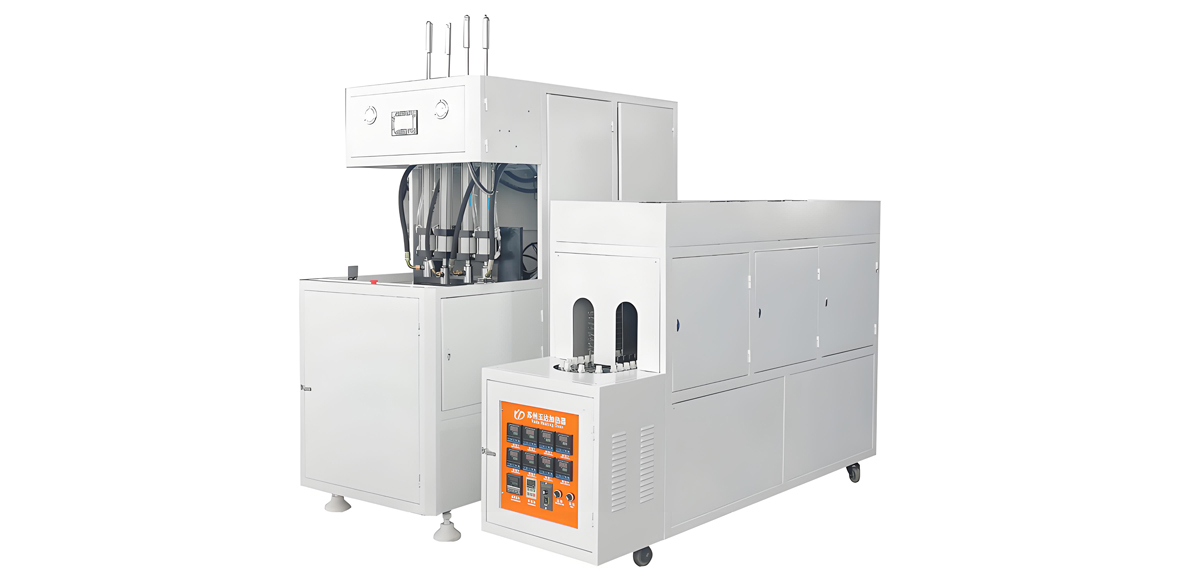
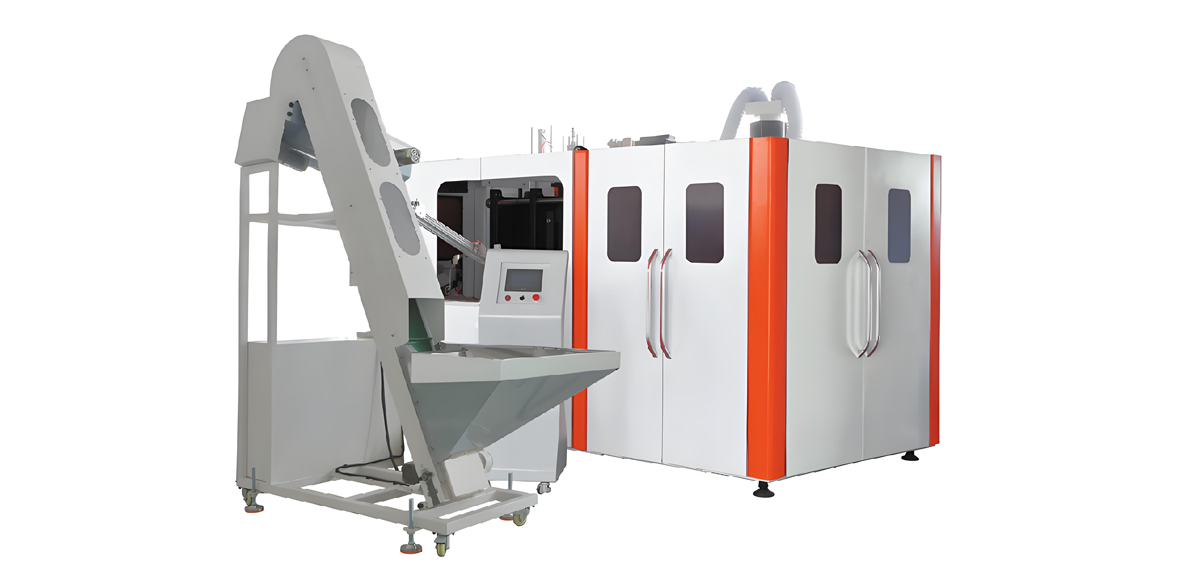
The full automatic standard-speed range from 1,000 to 7,000 bottles per hour carries the same heating and clamping architecture as the high-speed platform but with a shorter oven and fewer stations, which makes it the correct choice for regional carbonated brands, for plants running many small batches, and for second lines dedicated to large-format bottles. The semi-automatic series lowers procurement cost substantially by separating heating and blowing into two operator-attended steps, and it remains a sensible entry point for a startup that wants to prove a carbonated product in the market before committing to a full automatic line, provided the operator understands that consistency depends on manual handling discipline. For plants where floor area is the binding constraint, YuDa also builds a linear blowing-filling-capping CombiBlock and a bottle blow-filling-capping machine that form the bottle, fill it, and apply the closure inside one enclosure; on carbonated products the combined block is best suited to lower gas volumes and smaller formats, while high-carbonation cola-type products at national volumes are still more robustly served by a separate blowing machine feeding a dedicated isobaric filler through an air conveyor.
Filling, Capping, and Downstream Packaging
Carbonated filling is counter-pressure filling. The rotary filler first purges each bottle with carbon dioxide to displace air, then pressurizes the bottle to the same pressure as the product bowl, typically 3.5 to 5 bar, so that liquid flows in under gravity without breaking out of solution; only after a controlled snift-off does the bottle release its excess pressure and travel to the capper. Product temperature at the valve is held at 2 to 6 degrees Celsius for the same solubility reason discussed earlier, and valve count follows from line speed: a 12,000 bottle per hour line usually runs 40 to 60 filling valves at a modest rotational speed rather than a small carousel spinning fast, because centrifugal agitation of a supersaturated liquid causes foaming and underfill. The capper is normally combined on the same base frame, applying a 28 millimeter plastic screw closure at a torque of 1.4 to 2.2 newton meters, fed from a hopper elevator through a cap sorter and, for many markets, a cap rinser or ultraviolet sterilizer. Fill height accuracy of plus or minus 2 millimeters and closure torque repeatability are the two variables that most often trigger consumer complaints on carbonated products, because both translate directly into lost gas volumes on the shelf.
Downstream of the capper the packaging section handles a cold, wet, pressurized container. A bottle warmer tunnel that sprays recirculated warm water and raises surface temperature to a few degrees above ambient dew point is effectively mandatory, since condensation on a cold bottle prevents label adhesive from bonding and makes shrink film wrinkle. After warming, the line runs a roll-fed hot melt labeler or a shrink sleeve applicator, an inkjet or laser coder for batch and expiry information, and an inspection station that checks fill level, cap presence and cocked caps, and label position, with a reject conveyor that removes failures without stopping the line. An empty bottle inspector belongs upstream of the filler, and a leak detector after capping is worthwhile on carbonated lines because a marginal closure will not fail immediately. Final packing is either a shrink film wrapper producing multipacks, a wrap-around case packer, or both, followed by a divider or handle applicator on large formats, a conveying system with accumulation tables sized for at least ninety seconds of line output, and a layer or robotic palletizer with a stretch wrapper. Accumulation is the unglamorous element that determines real plant efficiency: without it, every ten-second stop at the labeler propagates backward to the filler and forward to the palletizer.
Utilities, Compressed Air, and Cooling
| Utility | Duty at 12,000 BPH | Note |
|---|---|---|
| High-pressure air, 40 bar | 7.0 – 8.5 Nm3/min | Lower with air recovery |
| Low-pressure air, 8 bar | 2.0 – 2.5 Nm3/min | Valves, conveying, capper |
| Chilled water, 8 – 12 C | 90 – 110 kW | Molds and neck cooling |
| Glycol, 2 C | 150 – 200 kW | Product cooling and carbonation |
| Power, blowing block | 180 – 260 kW installed | Ovens dominate the load |
| Carbon dioxide | 5 – 7 kg per 1,000 L | 99.9 percent beverage grade |
The high-pressure air system is the second most expensive machine in the plant after the blowing machine and the filler, and it deserves the same specification discipline. A four-stage oil-free or oil-lubricated piston compressor delivering 40 bar is the standard solution, sized on the calculation that each 500 milliliter carbonated bottle consumes roughly 25 to 30 normal liters of high-pressure air once machine dead volume and valve losses are counted. Always specify a receiver of at least 2 cubic meters at working pressure to absorb the pulsation of the blowing cycle, a refrigerated or desiccant dryer bringing the pressure dew point to at least minus 20 degrees Celsius, and a filtration train down to 0.01 micrometer with activated carbon on the final stage, since air touching the inside of a food container is a food contact medium. Cooling is split into two circuits for good reason: mold cooling wants 8 to 12 degrees Celsius water at high flow and moderate temperature stability, while product cooling wants a glycol circuit at around 2 degrees Celsius, and combining them forces one circuit to run at the wrong temperature. In ambient conditions above 35 degrees Celsius, add fifteen to twenty percent to nominal chiller capacity, and prefer a water-cooled chiller with a cooling tower over an air-cooled unit when water is available, because the efficiency gap widens exactly when the plant is busiest.
Total electrical demand for a complete 12,000 bottle per hour carbonated plant, including water treatment, syrup room, chillers, compressors, blowing, filling, and packaging, typically lands between 750 and 1,000 kilowatts of installed capacity with measured consumption in the range of 30 to 45 kilowatt hours per 1,000 bottles for 500 milliliter formats. That figure is the honest way to compare investment options, because a machine with a lower purchase price and a wide-gap oven can consume enough extra electricity to erase the initial saving within two to three years of two-shift operation. Using a cost index where a mid-range full automatic carbonated line is set at 100 basis points, the blowing block usually represents 22 to 28 points, the filling and capping monoblock 25 to 32 points, water treatment and syrup 12 to 16 points, utilities including compressors and chillers 14 to 18 points, and packaging plus conveying the balance. Relative operating cost intensity is High for electricity, Medium for carbon dioxide and water, and Low for spare parts on a well-maintained line, and the single largest controllable variable across all of them is preform temperature stability.
Choosing the Right Machine Configuration
| Requirement | Bottle | Recommended YuDa Machine |
|---|---|---|
| Market trial, lowest entry cost | 1.5 L carbonated | Semi-automatic two-cavity |
| 1,000 – 1,500 BPH startup | 500 ml carbonated | Full automatic single-cavity |
| 3,000 BPH regional brand | 1.5 L and 2 L | Full automatic two-cavity |
| 6,000 – 7,000 BPH | 500 ml carbonated | Full automatic six-cavity |
| 10,000 – 12,000 BPH | 330 – 600 ml | FGX four-cavity high speed |
| 15,000 BPH national volume | 500 ml carbonated | FGX five or six-cavity |
Selection starts with the bottle, not the machine. Provide the target volume, the intended gas volumes, the neck finish, the preform gram weight and length, the required output in bottles per hour, the number of formats to be produced on the same machine, and the plant ambient temperature, and the configuration follows almost deterministically. Two practical rules save money at this stage. First, size the blowing machine ten to fifteen percent above the filler rather than matching them exactly, because the air conveyor between them acts as a buffer and a slightly faster blower keeps the filler saturated through minor stops; a blowing machine running as the bottleneck will be pushed beyond its comfortable oven window and bottle quality will drift. Second, decide the format family before ordering, since a machine optimized for 330 to 600 milliliter bottles and one optimized for 1.5 to 2 liter bottles differ in mold clamping stroke, stretch rod length, oven length, and air consumption, and retrofitting a small-format machine to run large formats later costs far more than specifying a dual-capability machine at the outset. Where a plant genuinely needs both families at volume, two dedicated machines almost always outperform one compromise machine on total output and on changeover time.
Application Industries and End Products
Carbonated soft drinks are the demanding end of a much wider application range that the same equipment family serves. Cola-type and citrus-flavored soft drinks at 3.8 to 4.2 gas volumes sit at the top of the pressure requirement, followed by sparkling water and tonic at 4.0 to 4.5 volumes in smaller formats, flavored sparkling beverages and energy drinks at 2.5 to 3.5 volumes, and carbonated malt or beer-style beverages that add light-barrier and oxygen-barrier considerations on top of pressure. Below that tier, the same blowing machines produce still water bottles, juice and tea bottles for hot-fill or aseptic lines, edible oil containers, dairy and yogurt drink bottles, and containers for daily chemical and cosmetic products such as shampoo, liquid detergent, and toner. Food and beverage contact brings its own compliance framework rather than a purely mechanical one: PET resin and finished containers are commonly evaluated against FDA 21 CFR 177.1630 in the United States, Regulation EU 10/2011 in Europe, and GB 4806.6 in China, while the machines themselves are supplied with CE marking and built under ISO 9001 quality systems. Bottle-level verification typically covers burst pressure, environmental stress cracking with a caustic soak, and a thermal stability test in which pressurized bottles are held at 38 degrees Celsius for 24 hours and checked for volumetric expansion below about three percent with no loss of base clearance.
The practical consequence for a plant owner is that the machine list must be chosen against the widest product the plant intends to sell within five years, not the narrowest one it will launch with. A plant that specifies for still water and then adds a carbonated line extension discovers that the preform inventory, the neck finish tooling, the filler valve design, and often the high-pressure compressor all need replacement, whereas a plant that specifies for carbonated products can produce still water on the same equipment at lower blow pressure and lighter preforms with no hardware change at all. Specifying upward is inexpensive; specifying downward is not.
Layout, Commissioning, and After-Sales Support
Plant layout for a carbonated line follows a straight product path with utilities on the perimeter. A 12,000 bottle per hour plant typically occupies 800 to 1,200 square meters for the production hall, with the water room and syrup room in a separately enclosed and hygienically finished area, the compressor and chiller room isolated for noise and heat, and the blowing machine positioned so that its air conveyor reaches the filler with a gentle rise and no sharp direction changes. Allow floor loading of at least 1,000 kilograms per square meter under the blowing machine and filler, a clear height of 4.5 to 6 meters for the air conveyor and warehouse crane access, ambient ventilation sized to remove the oven and compressor heat rejection, and drainage trenches under the filler and warmer. Leave a maintenance corridor of at least 1.2 meters on the mold-change side of the blowing machine; layouts that save floor space by narrowing that corridor pay for it every single changeover for the life of the plant. Utility rough-in, three-phase power distribution, compressed air piping in stainless or aluminum rather than carbon steel, and a floor drain plan should all be settled before the machines are shipped, which is why layout drawings are prepared in parallel with manufacturing rather than after delivery.
Every YuDa machine is assembled and tested with preforms before it leaves the factory, so the customer receives blown sample bottles and recorded process parameters rather than a machine that has only been electrically checked. Wanplas backs each installation with the group service commitments shared across all its factories: engineers on site for installation and commissioning, operator and maintenance training on the customer’s own product and preform, USD 500 of free spare parts every year, free replacement of parts that fail within the warranty period, a transportation guarantee, and a production capacity guarantee that ties the contract to the output figure rather than to a catalog number. Remote monitoring lets headquarters engineers inspect controller data and process trends without travel, which resolves most parameter and sensor issues within hours instead of days. Wanplas also maintains an open factory policy, so customers are welcome to walk the assembly floor, watch their own machine being built, and run trial production with their own preforms and molds before shipment.
Frequently Asked Questions
Can a water bottle machine make carbonated bottles?
Usually not without modification. Carbonated bottles need 35 to 40 bar final blow pressure, a petaloid base mold, a longer heating oven for heavier preforms, and higher planar stretch ratios. A machine specified for still water at 25 to 30 bar will produce bottles that pass a first visual check and then fail thermal stability or stress cracking tests. Specify for carbonated duty and run water on the same machine, never the reverse.
What blow pressure do carbonated PET bottles need?
Pre-blow at 8 to 12 bar and final blow at 35 to 40 bar are the normal windows, with the upper end used for large formats and for deep petaloid bases. The high-pressure compressor must hold that pressure under the pulsating demand of the blowing cycle, which is why a receiver of at least 2 cubic meters and a dew point of minus 20 degrees Celsius or better are part of the specification rather than optional extras.
How heavy is a 500 ml carbonated preform?
Typically 22 to 28 grams, against 12 to 15 grams for a still water bottle of the same volume. A 1.5 liter carbonated bottle runs 38 to 45 grams and a 2 liter runs 48 to 54 grams. Lightweighting below those ranges is possible only with optimized base geometry, higher intrinsic viscosity resin, and tight process control, and it should always be validated by burst and creep testing rather than by appearance.
Which neck finish suits carbonated drinks?
A 28 millimeter carbonated profile is the industry default, available in a conventional taller version and a short version that saves roughly one gram of resin per bottle. The choice must be consistent across preform supply, blow mold neck inserts, filler valve centering, capper chuck, and closure supply. Changing neck finish later is a tooling project across several machines, not a simple part swap.
How long does a mold changeover take?
On a modularized full automatic machine, a trained two-person team changes a four-cavity mold set in about 45 to 90 minutes including stretch rod adjustment, base mold height setting, and the first-article check. Format changes that also alter preform length or neck finish take longer because oven lamp profiles and chain pitch settings must be reset. Keeping a second mold set preheated and pre-plumbed is the most effective way to shorten the process.
Is a bottle warmer necessary after cold filling?
Yes, on almost every carbonated line. Product leaves the filler at 2 to 6 degrees Celsius, so condensation forms on the bottle wall immediately and prevents hot melt label adhesive from bonding and shrink film from setting cleanly. A warmer tunnel raising surface temperature above the ambient dew point solves both problems and also reduces stress on the closure seal before palletizing.
Build Your Carbonated Line with YuDa
A carbonated PET bottle plant is a system, and its weakest specification sets its real output. If you share your target bottle volume and gas volumes, preform gram weight and neck finish, required bottles per hour, the number of formats you plan to run, and your plant ambient temperature and available power, YuDa engineers will return a complete machine list with cavity count, oven configuration, compressor and chiller duty, utility loads, and a scaled plant layout matched to your building. Send a sample bottle or a drawing and the team will run trial blowing with your own preforms before anything is manufactured, or arrange a factory visit to watch a comparable line in production and inspect the build quality first hand. YuDa Machinery, a Wanplas factory, has spent more than twenty years on PET bottle blow molding alone, and that focus is what turns a machine list into a plant that hits its numbers.