YuDa Machinery is a Wanplas factory and one of China’s leading manufacturers of PET bottle blow molding machines, with over 20 years of specialization, exports to more than 60 countries, a top-two domestic market position, and more than 20 patents in blow-molding technology. This guide explains how to build a high-yield production solution for PET mineral water and carbonated soda bottles, covering machine selection, line architecture, energy optimization, and the engineering details that separate a reliable high-output line from a troublesome one.
PET has become the dominant material for bottled water and carbonated soft drinks because of its clarity, strength-to-weight ratio, recyclability, and the maturity of two-step stretch blow molding. Mineral water is a still, ambient-filling product, while soda requires a bottle engineered to contain dissolved carbon dioxide at pressures up to about 8 bar. Both products run on the same family of PET blow molding machines, but the preform design, bottle geometry, and process window differ. The following sections show how a producer can size, configure, and operate a line that delivers 8,000 to 15,000 bottles per hour with stable quality.
Why PET Dominates Bottled Water and Carbonated Drinks
PET, or polyethylene terephthalate, offers the combination of optical clarity, mechanical strength, low weight, and food-contact safety that bottled beverages require. For mineral water, the bottle must protect taste and resist any off-flavor migration. For soda, the bottle must retain carbonation and survive the hoop stress of pressurization. Stretch blow molding orients the PET molecules biaxially, which simultaneously increases tensile strength and improves the gas barrier.
Biaxial orientation is the core reason PET works for pressure applications. During stretch blow molding, the preform is reheated to a uniform temperature and then stretched axially by a stretch rod and radially by blow air. The resulting molecular orientation locks in strength and reduces gas permeability. A well-oriented bottle wall is thinner yet stronger than an unoriented one, which is how lightweighting saves resin without sacrificing performance.
Intrinsic viscosity, abbreviated as IV, is the primary resin specification for bottle grade PET. Water and soda preforms normally use an IV between 0.70 and 0.84 deciliters per gram. Carbonated drinks trend toward the higher end because the higher molecular weight improves the stress-crack resistance needed under pressure. YuDa machines accept the standard bottle-grade PET preform range and process both virgin and rPET blends within that window.
Acetaldehyde control is a defining concern for mineral water. PET can generate trace acetaldehyde during processing, and acetaldehyde imparts a slight fruity off-taste that water brands are sensitive to. Two-step reheat processes keep preforms away from the high thermal load of an integrated machine, which helps limit acetaldehyde formation. YuDa’s heating control and stable oven temperature profile further support low and consistent acetaldehyde levels.
Recyclability strengthens the business case. PET is the most recycled plastic bottle stream in the world, and rPET content is now a purchasing criterion for many beverage brands. A blow molding line that accepts rPET preforms lets a filler meet recycled-content commitments. Wanplas, as the parent brand, supports customers across the value chain when broader recycling or extrusion integration is needed.
Two-Step Versus One-Step Line Architecture
In the two-step, or reheat stretch blow molding, process, preforms are first produced by an injection molding machine and then conditioned, reheated, and blown into bottles. This decouples preform production from blowing, allowing the blow machine to run at full speed independent of the injection cell. For high-yield plants, the two-step layout is the standard because it enables parallel scaling and easier maintenance.
The one-step process integrates injection, conditioning, and blowing into a single machine. It reduces thermal history because the preform moves directly from the mold to the blow station without a separate reheating cycle. That lower thermal load benefits sensitive products such as water where acetaldehyde must stay minimal. The trade-off is a lower single-line output and tighter coupling between stations.
For a high-yield water and soda plant, the two-step architecture is recommended. The preform injection cell can run continuously and feed a buffer, while one or more blow machines draw from that buffer. If one blow module needs service, the others keep producing. This redundancy is valuable at 10,000 plus bottles per hour where any downtime is measured in lost cases per minute.
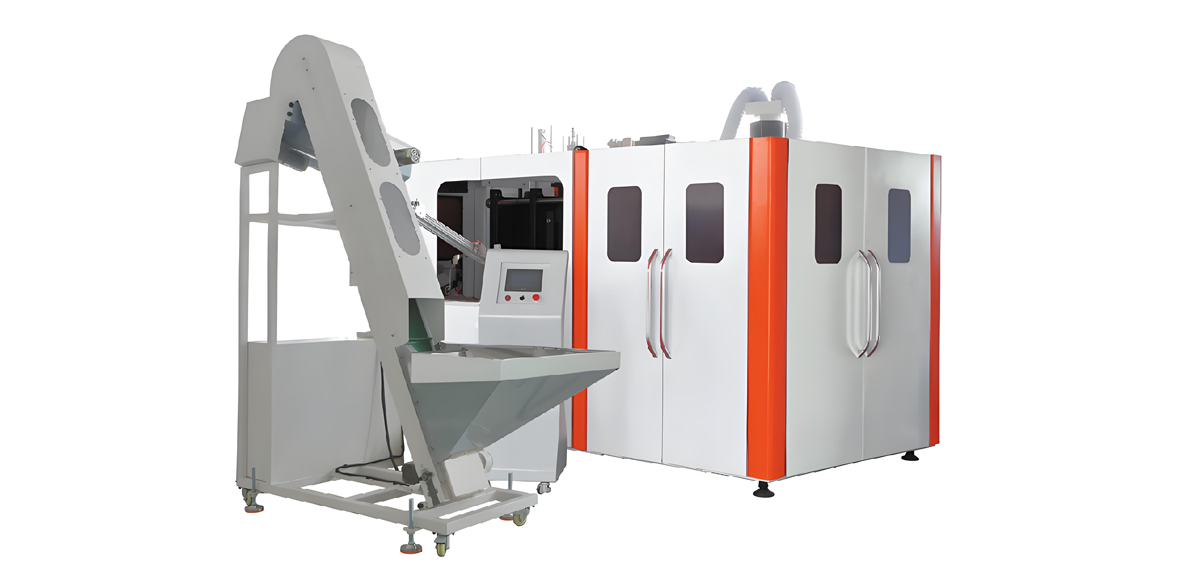
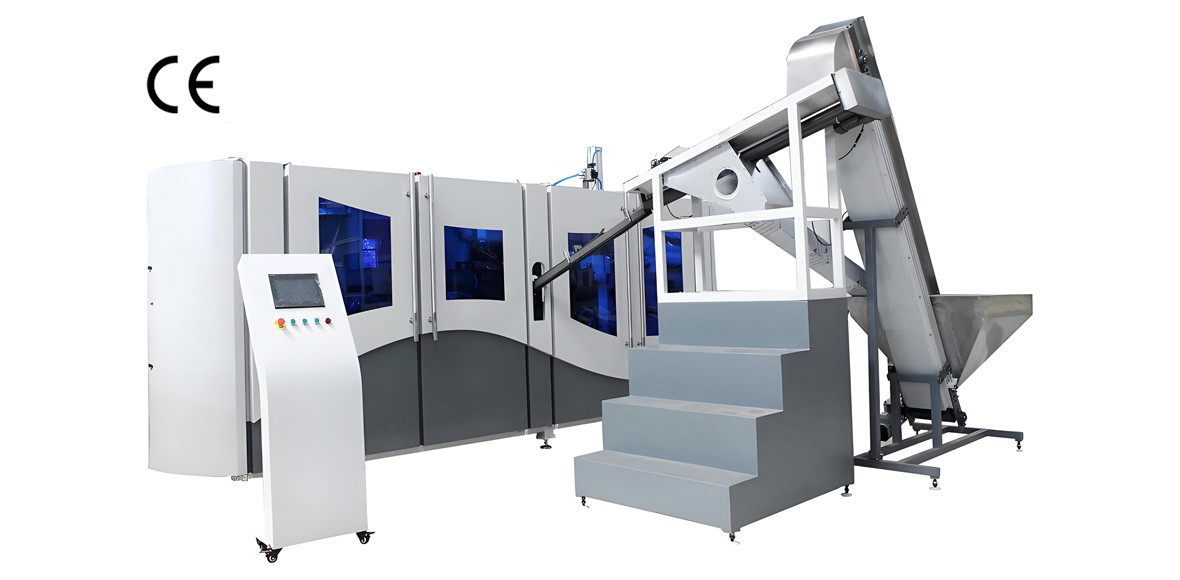
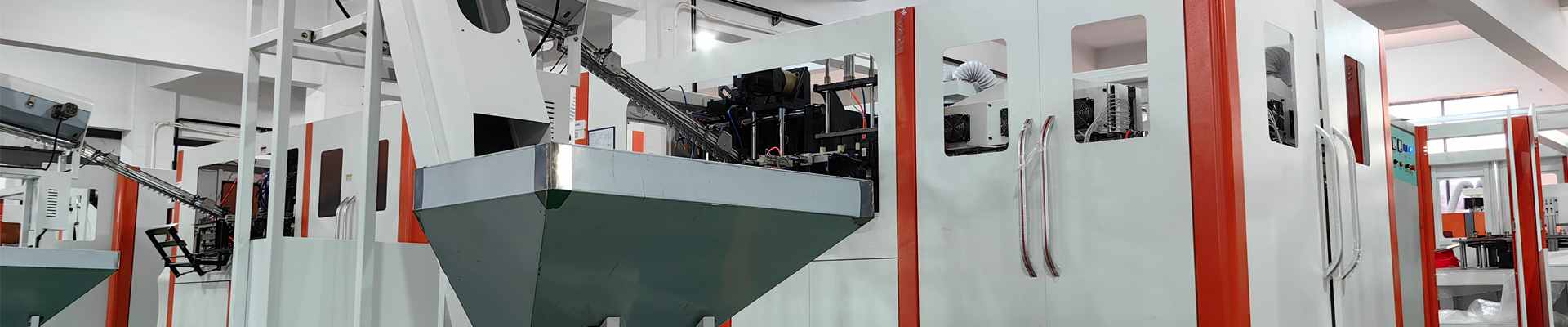
Preform handling and storage matter more than many buyers expect. Two-step lines need a clean, temperature-controlled preform buffer and a destacker that orients preforms for the oven. Dust, moisture, or mixed preform lots cause rejects. YuDa’s standard layout integrates the preform feeder, oven, blowing wheel, and bottle discharge into a compact footprint that simplifies material flow on the factory floor.
A complete high-yield line also includes air systems. Blow molding uses both low-pressure and high-pressure compressed air, with the high-pressure stage often recovering energy through a booster. YuDa’s modular design makes it straightforward to pair the blow machine with the customer’s existing compressor capacity or with a recommended air station sized for the target cavities and output.
YuDa FGX High-Speed Series for 8,000 to 15,000 BPH
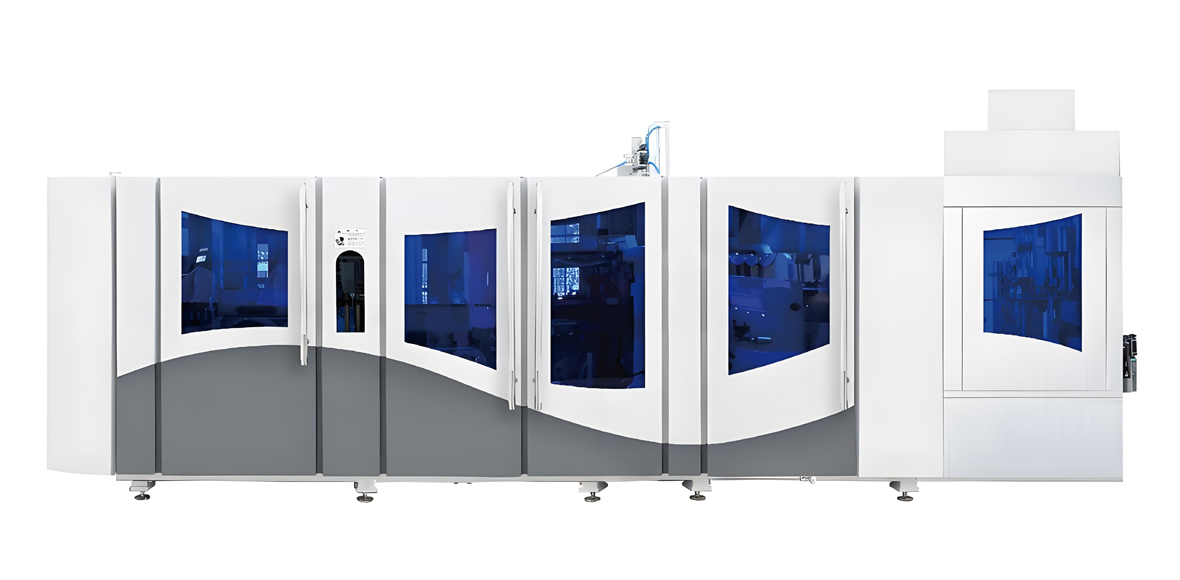
YuDa’s FGX series high-speed PET bottle blow molding machines are engineered for continuous high-output operation. A single blowing unit delivers 2,500 to 3,000 bottles per hour per mold, and multi-cavity configurations scale the line to 8,000 to 15,000 bottles per hour. The design uses a cam linking system that integrates mold-opening, mold-locking, and bottom-mold elevation into one synchronized movement, driven by a high-speed servo system.
The cam linking mechanism removes the lag between successive motions that slows conventional linkages. Because mold opening, locking, and base elevation happen as one coordinated stroke, the cycle time drops and the output per cavity rises. At high speeds, this synchronization is the difference between a rated capacity that holds up in production and one that only appears on a brochure.
The FGX series uses mature, stable component brands for the servo drives, valves, and sensors. High-speed lines live or die by component consistency because a single unreliable valve causes cavitation, short shots, or base failures at thousands of bottles per hour. YuDa’s component strategy favors proven, serviceable parts that are available through global supply channels.
Modular construction is a practical advantage for high-yield plants. Molds, ovens, and transfer components are built as modules so changeovers and maintenance are faster and cheaper. When a beverage producer switches from a 500 milliliter water bottle to a 1.5 liter soda bottle, the modular layout shortens the reconfiguration window and reduces lost production.
| Parameter | FGX High-Speed (compact) | FGX High-Speed (multi-cavity) |
|---|---|---|
| Output range | 8,000 to 10,000 BPH | 12,000 to 15,000 BPH |
| Single-mode speed | 2,500 to 3,000 BPH | 2,500 to 3,000 BPH per mold |
| Bottle volume | 0.2 to 2.0 L | 0.2 to 2.0 L |
| Cavity number | 4 to 6 | 8 to 12 |
| Drive system | Servo cam linking | Servo cam linking |
| Heater spacing | 38.1 mm | 38.1 mm |
| Energy saving | 30% plus vs conventional oven | 30% plus vs conventional oven |
| Monitoring | Remote PLC data | Remote PLC data |
The table above summarizes the two representative FGX configurations. The compact version fits plants ramping toward 10,000 BPH, while the multi-cavity version targets large regional bottlers and private-label fillers that need 12,000 to 15,000 BPH from a single line.
Energy-Saving Heating and Servo Drive Technology
Heating the preform accounts for the largest share of a blow machine’s power draw. YuDa minimizes the heater spacing to 38.1 millimeters, which reduces radiated heat loss and cuts electricity use by more than 30 percent compared with conventional heating ovens of the same cavity count. Over a year of three-shift operation, that saving is a meaningful line-item reduction on the plant’s energy bill.
Tighter heater spacing is not only about distance. It works together with individually controlled infrared lamp zones, reflective oven liners, and closed-loop temperature feedback. The oven holds each preform at its ideal stretch temperature band so the material reaches uniform viscosity before blowing. Uniform temperature means fewer thick spots, fewer base failures, and less scrap.
Servo drive technology replaces older pneumatic or hydraulic motions with precise electric actuation. Servo systems deliver the exact force and speed profile each motion needs, then recover or idle energy when the motion is complete. The result is lower peak demand and steadier consumption. For a 15,000 BPH line running around the clock, servo efficiency compounds into a large annual saving.
Compressed air strategy is the other major energy lever. High-pressure blow air can be recovered and reused across cavities through a properly sized recovery tank and booster. YuDa’s modular air interface lets the plant engineer match compressor capacity to actual demand rather than over-specifying a permanently idling compressor.
Energy optimization on a high-yield PET line is a system problem, not a single part. The 38.1 millimeter heater spacing, servo motions, and recovered blow air together define the line’s operating cost per bottle.
YuDa Standard-Speed Series for Mid-Volume Lines
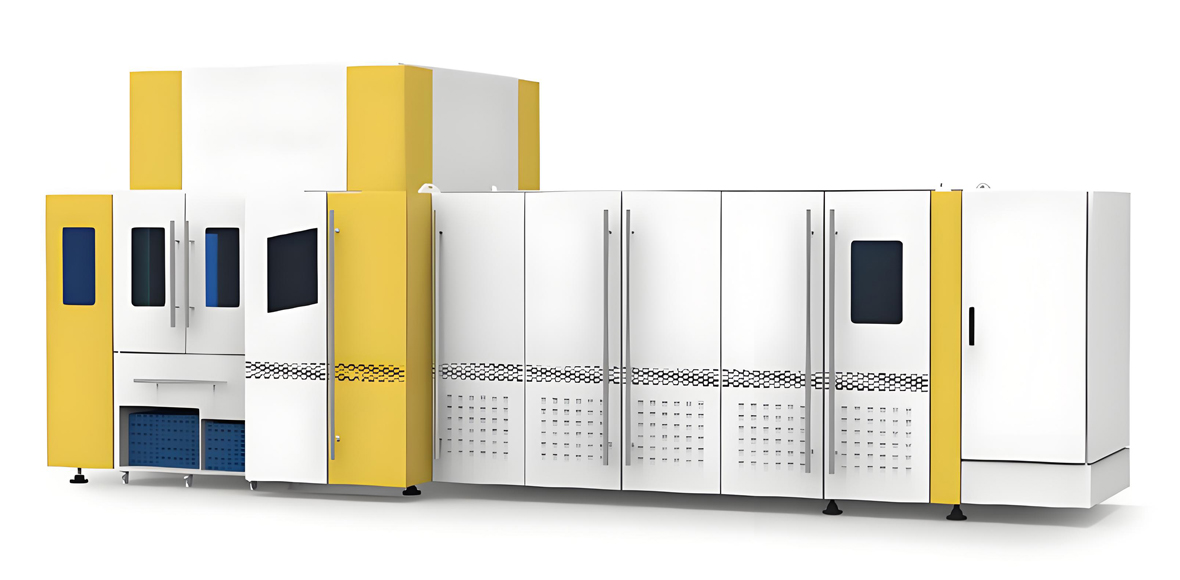
For plants needing 1,000 to 7,000 bottles per hour, the YuDa standard-speed full-automatic series provides advanced heating and energy-saving technologies at a lower capital level. These machines share the same engineering philosophy as the FGX series but are tuned for moderate output where the highest cavity count is not required.
The standard-speed series suits regional water brands, soda contract packers, and fillers adding a second or third line. It keeps the 38.1 millimeter heater spacing and the modular mold concept, so a producer can later scale up by adding cavities or moving to the FGX series without relearning the control platform.
Operation is managed through a touch-screen HMI with recipe storage. An operator selects the bottle recipe, and the machine applies the correct oven temperature profile, stretch timing, and blow pressure. Recipe management reduces changeover error and makes it practical to run multiple SKUs on one line across a shift.
| Parameter | Standard-Speed Series |
|---|---|
| Output range | 1,000 to 7,000 BPH |
| Bottle volume | 0.2 to 2.0 L |
| Cavity number | 2 to 6 |
| Heating | 38.1 mm spacing, zoned IR |
| Control | Touch-screen HMI, recipe storage |
| Drive | Servo or hybrid servo-pneumatic |
| Best fit | Regional brands, contract packers |
The standard-speed series is the workhorse for mid-volume bottlers. It delivers the reliability and energy behavior of the YuDa platform while keeping the initial investment aligned with plants that are not yet at 10,000 plus bottles per hour.
Engineering Differences: Still Water Versus Carbonated Soda
Carbonated soda bottles must withstand internal pressure, so they use heavier preforms, reinforced bases, and pressure-rated neck finishes. Still water bottles are lighter and optimized for material saving because they face no pressurization. The table below compares the key engineering parameters that a line designer must set differently for each product.
| Design factor | Still mineral water | Carbonated soda (CSD) |
|---|---|---|
| Internal pressure | Near atmospheric | Up to about 8 bar |
| Preform gram weight | Light, material-optimized | Heavier for hoop strength |
| Neck finish | Standard water neck | Pressure-rated PCO style |
| Base design | Simple, light base | Reinforced base support |
| PET intrinsic viscosity | 0.70 to 0.80 | 0.78 to 0.84 |
| Wall orientation | Moderate | High biaxial orientation |
| Typical volume | 0.33 to 2.0 L | 0.25 to 2.0 L |
The base of a carbonated bottle deserves special attention. A pressure bottle uses a base support geometry, sometimes called a punt, that resists inversion and distributes hoop stress. If the base is poorly blown or the preform temperature is uneven, the bottle wobbles or fails on the filler. YuDa’s bottom-mold elevation in the cam linking system helps form a consistent, symmetric base across all cavities.
Neck finishing is the second pressure-critical feature. Soda bottles use a pressure-rated finish with appropriate thread and support ring geometry so the cap seal holds against internal pressure and the bottle grips the filling chuck. The blow mold must hold the neck dimensions tightly because the filler references the neck for handling and capping.
Preform Specification and Bottle Weight Planning
Preform selection sets the ceiling on bottle quality and the floor on material cost. The preform gram weight must be high enough to fill the bottle wall at the target thickness yet low enough to stay competitive on resin. For still water, the industry trend is aggressive lightweighting; for carbonated soda, the preform also carries the internal pressure load and cannot be cut as thin.
A practical planning method starts from bottle volume and target wall thickness. A 500 milliliter water bottle commonly uses a preform in the 12 to 18 gram range, while a 1.5 liter bottle uses roughly 30 to 40 grams. Carbonated variants usually add 10 to 20 percent of preform weight to resist pressure without thickening the wall unevenly. The table below gives representative starting points; the exact number is fixed during bottle design and confirmed by trial blow.
| Bottle volume | Still water preform | Carbonated soda preform | Notes |
|---|---|---|---|
| 0.33 L | 9 to 12 g | 11 to 14 g | Small, light formats |
| 0.5 L | 12 to 18 g | 14 to 22 g | Single-serve standard |
| 1.0 L | 20 to 28 g | 24 to 34 g | Mid family size |
| 1.5 L | 30 to 40 g | 34 to 46 g | Large family size |
| 2.0 L | 38 to 50 g | 44 to 56 g | Maximum still water range |
Preform neck and color are planning items as well. The neck must match the filler and cap specification; the color can be natural, light blue, or custom tint. Colored preforms are molded in separate runs, so a bottler should forecast volumes by color to avoid holding preform inventory that will not be used. YuDa’s recipe and mold flexibility let a plant switch preform programs quickly, but preform sourcing remains a scheduling task for any high-yield line.
Resin intrinsic viscosity ties back to the earlier material discussion. Water preforms sit near 0.72 to 0.78 IV, while soda preforms sit near 0.80 to 0.84 IV. Buying the correct IV grade avoids both brittleness at low IV and unnecessary cost at high IV. When rPET is part of the program, the IV and contamination level of the recycled flake must be qualified so the finished bottle meets the same performance as virgin resin, especially for carbonated applications where the pressure margin is smaller.
Finally, preform storage conditions affect blowing. Preforms absorb moisture and pick up dust if stored poorly, and both reduce bottle quality. A clean, dry, temperature-stable preform buffer protects the investment in a high-speed line and keeps rejection rates low across long production runs.
The label panel and base cup also depend on preform design. A flat, well-defined label panel improves print registration, and a stable base cup keeps the bottle upright on conveyor and shelf. These features are built into the preform and mold together, which is why bottle design should be finalized with the blow mold supplier rather than treated as a separate afterthought.
How to Select the Right YuDa Configuration
Selecting the right configuration starts from three numbers: target output in bottles per hour, bottle volume, and product type. The table below maps common requirements to the recommended YuDa model and typical cavity count. These are starting points; the final configuration is confirmed after the customer shares preform drawings and bottle samples.
| Requirement | Recommended model | Cavities | Output |
|---|---|---|---|
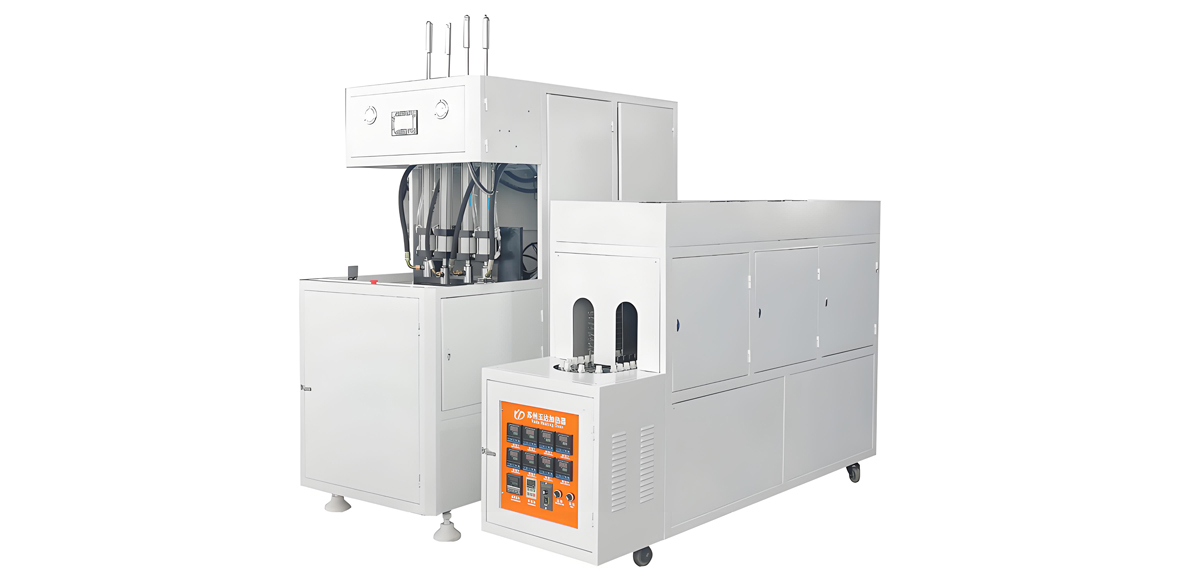
| Startup water, 0.5 to 1 L | Semi-auto series | 2 to 4 | 1,000 to 2,500 BPH |
| Regional water, 0.33 to 2 L | Standard-speed series | 4 to 6 | 3,000 to 7,000 BPH |
| High-volume water | FGX high-speed | 6 to 8 | 8,000 to 12,000 BPH |
| High-volume soda (CSD) | FGX high-speed | 8 to 12 | 12,000 to 15,000 BPH |
| Water plus filling in one cell | Linear BFC combiblock | Compact | Integrated, area-saving |
When a plant wants blowing and filling in one compact cell, YuDa offers the linear blowing-filling-capping combiblock and the bottle blow-filling-capping machine. These units blow the PET bottle and then fill and cap it in a single process, saving plant area and reducing bottle handling. For broader filling-line integration across the Wanplas group, the parent brand supplies matched filling and packaging capability.
Bottle volume interacts with output. A 2 liter soda bottle needs a heavier preform and longer blow time than a 500 milliliter water bottle, so the same machine produces fewer large bottles per hour. The selection table assumes representative mid-range volumes; a precise quotation fixes cavities to the exact bottle and target.
Application Industries and End Products
YuDa PET blow molding machines serve bottled water, carbonated soft drinks, flavored water, functional beverages, edible oil, and a wide range of food-contact containers. The food and beverage segment is the largest user because PET combines hygiene, clarity, and cost. The same line that makes water bottles can be reconfigured for many still and lightly carbonated drinks.
In the beverage industry, the end products include single-serve 0.33 and 0.5 liter bottles, family 1.5 and 2 liter bottles, and multipack formats for retail. Carbonated variants extend to cola, lemon-lime, tonic, and sparkling water. Each format is a mold and recipe change rather than a new machine.
Beyond drinks, PET bottles produced on YuDa machines appear in edible oil, condiments, and dry-food packaging where clarity and shelf appeal matter. The machines also support promotional and private-label runs, which is why recipe management and fast changeover are practical selling points for contract packers.
Export-oriented bottlers value the 60 plus countries of YuDa field experience. Machines are built to common international electrical standards and can be adapted to local voltage and ambient conditions. This global service history shortens commissioning for new plants in emerging markets.
Quality Control, Remote Monitoring, and Service Support
YuDa’s remote monitoring system lets engineers at the China headquarters read the PLC data through a mobile connection and receive abnormal-operation alerts from the client site. This capability turns a breakdown from a days-long wait into a same-day diagnosis. For a 15,000 BPH line, early fault detection protects output that would otherwise be lost.
Pre-shipment testing is standard. Each machine is run and verified before delivery so the customer receives a commissioned-ready unit rather than a project. YuDa engineers also perform on-site installation and commissioning, then train the customer’s operators on recipes, maintenance, and troubleshooting.
The shared Wanplas service policy strengthens the ownership experience. It includes USD 500 free parts every year, free replacement of damaged parts within the warranty window, a transportation guarantee, and a production-capacity guarantee. Quality standards are backed by a refund plus compensation commitment if quality falls short.
YuDa operates an open-factory policy. Customers are welcome to visit the plant, inspect the machines, and witness a trial run on their own preforms and bottle samples. A factory audit before purchase reduces the risk of mismatched expectations and confirms the line fits the intended products.
Frequently Asked Questions
What output can a single YuDa FGX line reach?
A single blowing unit delivers 2,500 to 3,000 bottles per hour per mold, and multi-cavity FGX configurations scale a complete line to 8,000 to 15,000 bottles per hour for water and soda bottles.
Can one machine produce both water and soda bottles?
Yes. The same stretch blow molding machine produces both, but carbonated soda requires heavier preforms, a pressure-rated neck finish, and a reinforced base. Recipe and mold changes are managed through the PLC.
How much electricity does the 38.1 mm heater spacing save?
Minimizing the heater distance to 38.1 mm reduces radiated heat loss and cuts electricity consumption by more than 30 percent compared with conventional heating ovens of the same cavity count.
What preform specifications are needed for carbonated drinks?
Carbonated drinks need a higher preform gram weight, an IV around 0.78 to 0.84, a PCO-style pressure neck finish, and a base engineered for base support to withstand internal pressure near 8 bar.
Does YuDa provide installation and commissioning?
Yes. YuDa engineers perform on-site installation and commissioning, run pre-shipment testing, and provide operator training. The shared Wanplas policy also includes USD 500 free parts every year.
How are spare parts handled after the warranty period?
YuDa keeps a spare-parts inventory and ships replacements quickly. The Wanplas group policy provides USD 500 free parts per year plus free replacement of damaged parts within the warranty window.
Is the FGX series suitable for rPET preforms?
Yes. The FGX series processes both virgin PET and rPET preforms within the supported intrinsic viscosity range, supporting recycled-content targets for bottled water and soda brands.
Conclusion
Building a high-yield PET bottle line for mineral water and carbonated soda starts with the two-step architecture, scales through the YuDa FGX high-speed series to 8,000 to 15,000 bottles per hour, and controls operating cost with the 38.1 millimeter heater spacing and servo drive technology. Carbonated products add preform weight, pressure-rated necks, and reinforced bases, while still water pushes for the lightest defensible wall.
YuDa Machinery, a Wanplas factory with over 20 years of experience and exports to more than 60 countries, supplies the FGX high-speed series, the standard-speed series, the semi-auto series, and the linear combiblock for bottlers of every scale. The shared Wanplas service policy, remote monitoring, and open-factory visits back every line with practical support.
If you are planning a water or soda bottle project, send your target output, bottle volume, and preform drawings so YuDa can propose a tailored configuration. You are also welcome to schedule a factory audit and a trial run on your own samples before placing an order.